Crypto & Finance RSS
Cointelegraph.com News

Fake romance crypto investment scams net $9 million in a single week in Hong Kong, as Malaysian authorities lose it over a crypto conference’s after-party.

The boutique brokerage will focus on high-net-worth clients rather than competing with retail crypto exchanges.
Bitcoinist.com
Backpack Exchange has listed TRON for both spot and perpetual trading, adding TRX/USD and TRX-PERP markets to its exchange lineup.
Backpack’s listing materials say the listing was announced on July 29, 2026, with TRX spot trading and perpetual contracts offering up to 10x leverage. For TRON, the listing gives traders another venue for accessing TRX markets, though it should not be overstated as a major change to global liquidity on its own.
Exchange listings matter, but not all listings are equal.
The real impact depends on volume, market-maker support, user demand, spreads, liquidity depth, and whether traders actually migrate activity to the new markets.
TL;DR
- Backpack Exchange has listed TRX spot and perpetual markets.
- Markets include TRX/USD and TRX-PERP.
- Perpetual contracts offer up to 10x leverage.
Why Spot And Perps Together Matter
A spot listing gives users direct access to buy and sell TRX.
A perpetual listing adds leveraged trading, hedging, and short exposure. For many active crypto traders, perps are where the real action happens because they allow more flexible positioning without needing to hold the asset directly.
Listing both spot and perpetual markets gives an exchange a fuller TRX trading stack.
That can help traders move between spot exposure and derivatives positioning without leaving the platform.
For TRON, it adds another venue where market participants can express views on the asset.
TRON Still Has A Large Stablecoin Role
TRON remains one of crypto’s most important networks for stablecoin transfers, especially USDT activity.
That gives TRX a different market profile from many altcoins. Traders do not only watch TRON as a speculative Layer 1. They also watch the network’s payment and stablecoin settlement role.
Exchange access can support that broader ecosystem, but a single listing does not transform network usage by itself.
The listing is useful because it expands trading options. It does not prove a new wave of TRON adoption.
Perpetuals Add Leverage Risk
The 10x leverage detail deserves caution.
Leverage can make markets more liquid and more efficient, but it can also amplify volatility. Perpetual markets often attract short-term traders, funding-rate strategies, hedgers, and speculative flows.
If open interest builds quickly, TRX may become more sensitive to liquidation cascades or crowded positioning on that venue.
That does not mean the listing is bad. It just means derivatives markets create a different risk environment than spot-only trading.
Users should understand that perpetual contracts are not simple token purchases.
Backpack Is Building Market Coverage
For Backpack, adding TRX expands its market coverage.
Exchanges compete by listing assets traders want, building reliable execution, attracting liquidity providers, and offering products across spot and derivatives. TRX is a logical addition because it is a large, liquid asset with an active global user base.
The question is whether Backpack can attract meaningful volume.
Listing the market is step one. Depth and sustained activity are what determine importance.
The Measured Read
The measured takeaway is that TRX now has spot and perpetual markets on Backpack Exchange.
That gives traders another route into the asset and expands product availability. It may support liquidity at the margin, but it should not be framed as a major adoption milestone unless volume data later supports that.
For TRON, the bigger story remains its stablecoin-transfer footprint and network utility.
For Backpack, the listing adds another recognizable asset to its exchange stack.
This article is based on Backpack Exchange listing materials for TRX spot and perpetual markets.
This article was written by the News Desk and edited by Samuel Rae.
This report is based on information released in disclosures at primary source documentation.
A proposed XRP Ledger amendment known as XLS-68 could let sponsors cover transaction fees and reserves for other users, making it possible for some wallet interactions to happen without the end user directly holding XRP.
The feature, included in the xrpld v3.3.0 amendment bundle, is part of a broader move toward fee abstraction and smoother user onboarding.
That does not mean XRP demand will definitely fall.
It means some users may be able to interact with applications while another party handles fees and reserves behind the scenes. For apps and wallets, that can make the user experience much simpler. For XRP holders, it raises a more nuanced debate about how fee abstraction affects native-token visibility.
TL;DR
- XLS-68 would allow sponsors to cover fees and reserves for other users.
- The proposal could make some XRPL interactions possible without users directly holding XRP.
- This is a UX change, not proof that XRP demand will fall.
Why Native Fees Create Friction
Most blockchains require users to hold the native asset for transaction fees.
That makes sense at the protocol level, but it creates onboarding friction. A new user may receive a stablecoin or token but still need XRP to move it. That adds an extra step, and every extra step loses users.
Fee sponsorship tries to solve that.
An app, wallet, exchange, business, or other sponsor can cover the fee and reserve requirements, letting the end user interact more smoothly.
This is common in broader crypto UX thinking. Many networks are trying to make blockchain fees less visible to mainstream users.
XRP Becomes Infrastructure, Not Always A User-Facing Asset
If sponsored fees work well, XRP may become less visible in some user journeys.
A person using an app may not need to think about acquiring XRP first. The app handles it. That can be good for adoption because it reduces friction, especially for consumer or enterprise products.
But it also changes how users perceive the native asset.
If users no longer directly hold XRP for every interaction, some traders may wonder whether fee demand weakens. That is the debate around the amendment.
The answer is not simple.
Sponsors still need a way to fund fees and reserves. Network activity still depends on the ledger’s economics. The question is who holds and spends XRP, not whether the network stops needing it entirely.
UX Improvements Can Increase Overall Activity
There is another side to the demand argument.
If sponsored fees make XRPL easier to use, the network may attract more applications and transactions. More users may interact with apps if they do not need to manage XRP directly on day one.
That could offset reduced user-facing fee friction.
In other words, XRP might become less visible per user but support more total activity if onboarding improves.
That is why it is too simplistic to say sponsored fees are bearish or bullish.
The real effect depends on adoption, sponsor behavior, transaction volume, reserve mechanics, and how apps implement the feature.
Enterprise Use Cases May Benefit Most
Fee abstraction is especially relevant for enterprise and consumer-facing products.
A bank, fintech, gaming app, payment company, or stablecoin issuer may not want users dealing with native-token balances just to complete basic actions. Sponsored fees let those companies hide some blockchain complexity while still using XRPL underneath.
That can make the ledger more attractive for tokenized asset or payment flows.
But again, this only matters if the amendment activates and builders use it.
A proposed feature is not adoption. It is infrastructure that may enable adoption.
Watch The Vote And Implementation
The next step is validator support.
Like other XRPL amendments, XLS-68 needs the required consensus threshold before activation. Until then, it remains a proposal in the release path, not a live feature reshaping user behavior.
If activated, the market can then watch how wallets and apps integrate it.
For now, the sponsored fees proposal is best understood as a UX and fee-abstraction story.
It may reduce the need for some users to hold XRP directly, but it could also make XRPL easier to use and expand application activity. The impact depends on what builders do next.
This article is based on XRP Ledger amendment materials related to XLS-68 sponsored fees and reserves.
This article was written by the News Desk and edited by Samuel Rae.
This report is based on information released in disclosures at primary source documentation.
NewsBTC
Bitcoin and Ethereum edged higher into July 31, while a small shift in market dominance suggested traders were again watching whether capital was rotating toward major altcoins.
The validated notes show Bitcoin rising 0.29% to about $64,145.86, while Ethereum traded around the $1,890 to $1,920 range, briefly dipping below $1,900 before recovering. At the same time, BTC and ETH dominance slipped slightly, pointing to a modest move into other crypto assets.
That is not enough to declare “altseason,” and it would be lazy to pretend otherwise.
But it is enough to say the market is becoming more selective. Bitcoin and Ethereum remain the anchors, while traders are scanning altcoins for relative strength, fresh narratives, and clearer catalysts.
For more details, visit the official Coinmarketcap platform.
TL;DR
- Bitcoin edged higher to roughly $64,145 on July 31.
- Ethereum traded near the $1,900 area after a brief dip.
- Slightly lower BTC and ETH dominance suggests traders are watching altcoin rotation, but not enough to call a broad altseason.
Rotation Is Usually Messier Than The Headline
Crypto traders love simple market-cycle labels.
Bitcoin season. Ethereum season. Altseason. Meme season. DeFi season. ETF season.
The reality is usually much messier. Capital rotates in stages, not all at once. Large caps may move first, then higher-quality altcoins, then more speculative assets. Sometimes rotation lasts days. Sometimes it fades quickly. Sometimes it is only a pause in Bitcoin dominance before BTC takes control again.
That is why the current market deserves a careful read.
Bitcoin and Ethereum are still holding the center. A slight dominance dip does not mean traders have abandoned them. It may simply mean that some capital is searching for better short-term setups elsewhere.
That can happen even while BTC and ETH move higher.
Bitcoin Still Sets The Tone
Bitcoin remains the first asset most traders watch.
When BTC is stable or rising gently, risk appetite often improves. Traders may become more comfortable moving into Ethereum, Solana, XRP, BNB, Chainlink, Sui, or other large-cap altcoins. When Bitcoin drops sharply, that appetite can vanish quickly.
So a modest BTC gain can create room for altcoin movement.
That does not make Bitcoin irrelevant. It makes Bitcoin the weather system the rest of crypto trades under.
At around $64,000, Bitcoin’s position is still strong enough to keep market confidence alive, but not necessarily explosive enough to absorb all attention. That can create the conditions for selective altcoin bids.
Ethereum’s Role Is Different
Ethereum’s position is a little more complicated.
ETH remains the largest smart-contract asset and a major institutional focus, but its market narrative now involves Layer 2s, ETF flows, stablecoins, DeFi revenue, mainnet fees, and competition from faster chains.
When Ethereum trades near $1,900, the market does not just ask whether ETH is rising. It asks whether Ethereum’s broader ecosystem is attracting capital.
If ETH stabilizes, some traders may look further down the ecosystem stack: Uniswap, Aave, ENS, Layer 2s, liquid staking, and other DeFi or infrastructure names. That is how Ethereum strength can sometimes spill into altcoins.
But again, that spillover is not automatic.
ETH can rise without DeFi tokens following. DeFi tokens can rally while ETH stalls. Rotation is never as clean as traders want it to be.
The Altcoin Market Is More Selective Now
The biggest difference from earlier cycles is selectivity.
In older bull phases, almost everything could move once traders decided risk was back. Now, the market is more fragmented. Liquidity is thinner in many assets. Investors are more sensitive to token unlocks, revenue, governance, emissions, legal risk, and actual usage.
That means altcoin rotation may favor stronger narratives rather than every token.
Real-world assets, stablecoin infrastructure, DeFi fee switches, AI compute, exchange-linked tokens, and major ecosystem upgrades may attract more attention than generic price charts.
This is healthier, even if it feels less euphoric.
A market where traders ask “what is the catalyst?” is more mature than one where every ticker moves simply because Bitcoin paused.
Watch Dominance, Not Just Price
The next useful signal is dominance.
If BTC and ETH keep rising while dominance continues to slip, that suggests broader participation. If dominance rebounds sharply, altcoin strength may fade. If BTC rolls over, most altcoins will likely struggle regardless of their individual setups.
So the right read is cautious optimism.
Bitcoin and Ethereum are steady enough to support risk appetite, and there are signs of selective rotation. But the market has not given enough evidence for a sweeping altseason call.
For now, traders are looking beyond the two largest assets, but they are not ignoring them.
That balance may define the next phase of the market.
This article is based on July 31 public crypto market data covering BTC, ETH, and market dominance.
This article was written by the News Desk and edited by Samuel Rae.
NEAR has launched a staking-based payment model for NEAR AI, giving users a way to lock NEAR tokens and receive monthly compute credits instead of paying through traditional cloud billing or credit-card rails.
According to the validated notes, the system gives users access to 43 hosted AI models, including models from OpenAI, Anthropic, and Google. The key detail is that tokens are not consumed. Users lock NEAR and receive compute credits proportional to their stake size.
That makes this more interesting than a simple payment integration.
NEAR is trying to tie token utility directly to AI usage. Instead of asking users to buy a token for speculative reasons, the model gives the token a role in accessing compute.
The question is whether users will actually adopt it at scale. But as a design direction, it is worth watching.
For more details, visit the official Near platform.
TL;DR
- NEAR has launched staking-based compute payments for NEAR AI.
- Users lock NEAR tokens and receive monthly compute credits.
- The model links token utility with AI model access, but adoption still needs to be proven.
Why AI Compute Payments Are Hard
AI usage has a very real payment problem.
Users and developers often pay through cloud accounts, credit cards, subscriptions, invoices, or platform credits. That works fine in traditional software, but it does not map neatly to autonomous agents, crypto-native users, or applications that want programmable access without conventional billing.
NEAR’s model tries to solve that by using staking as the payment layer.
Instead of spending tokens directly, users lock them. The locked stake determines monthly compute credits. That creates a different relationship between token ownership and product access.
The user is not simply paying a fee. They are committing capital to the network and receiving AI compute access as a benefit.
That could make sense for developers, agent builders, or users who already hold NEAR and want a reason to use it beyond staking yield or governance.
Tokens Are Not Consumed
The fact that tokens are not consumed is important.
If the model required users to spend NEAR every time they used an AI model, it would look more like a normal pay-per-use system. Locking tokens changes the economics because users retain ownership while receiving credits.
That may make the system feel less expensive for users, though there is still an opportunity cost. Locked tokens cannot be freely used elsewhere while committed, and their market value can move.
The model therefore resembles a membership or access system backed by staking.
That is a different kind of token utility, and crypto networks have spent years searching for utility models that do not rely only on speculation or inflationary rewards.
AI Agents Need Native Payment Rails
The autonomous-agent angle is where this gets more forward-looking.
If AI agents are going to operate independently, call models, use tools, pay for services, and make decisions in software environments, they need payment rails that are programmable. Traditional billing can work for human-managed accounts, but it becomes clunky when software agents are expected to act continuously.
Crypto rails may be useful there.
A staking-based compute model could let an agent or developer environment access AI resources based on locked capital rather than repeated card payments or centralized credentials.
That is still early. There are many open questions around permissions, safety, abuse controls, cost predictability, and user experience. But the direction fits NEAR’s broader focus on AI and agent infrastructure.
Don’t Overstate Adoption Yet
The caution is simple: launch is not the same as adoption.
NEAR may have a clever compute-credit model, but the market still needs to show whether users prefer it. Developers will compare it with direct API billing, cloud credits, open-source models, enterprise contracts, and other crypto-native compute markets.
The model also needs to be clear.
How many credits does a given stake generate?
Which models are available at what cost?
How predictable are credits over time?
Can teams build around it without worrying about token volatility?
Does the system attract users who were not already in the NEAR ecosystem?
Those questions will determine whether this becomes a real use case or a niche experiment.
A More Practical Token Utility Story
What makes the NEAR AI payment model interesting is that it gives the token a practical role.
Crypto has often struggled to explain why a token needs to exist beyond governance, gas, staking, or incentives. Linking token staking to AI compute access gives NEAR a more concrete utility narrative.
That does not guarantee success. But it is more useful than vague AI branding.
If users can lock NEAR and receive compute credits for models they actually use, then the token becomes part of a product loop. That is exactly what many networks are trying to build: token demand connected to real usage rather than just market cycles.
NEAR’s staking-based compute payments are still early, but they point toward a crypto-AI model that is more practical than most of the hype around the sector.
This article is based on NEAR AI materials describing staking-based compute credits and model access.
This article was written by the News Desk and edited by Samuel Rae.
CryptoPotato
Net loss came to $57.2 million, narrowed from $81.8 million in the first quarter. A $71.2 million non-cash loss on digital assets ran through operating expenses, and the operating loss was $74.1 million while Bitcoin fell about 12% over the quarter.
CryptoPotato reported on the $81.8 million first-quarter loss that landed alongside a then-record 817 Bitcoin mined in May.
Reserve Climbs Toward 8,300 Bitcoin
Eric Trump, Co-Founder and Chief Strategy Officer, said on X that the reserve had grown to roughly 8,300 BTC as of August 3 and described American Bitcoin as the “#16 Largest Publicly Traded Bitcoin Company in the World.”
Just wrapped $ABTC‘s earnings call
Q2 2026 was our strongest quarter of Bitcoin production yet. As of today, our Bitcoin reserve has grown to ~8,300 BTC!
Gross margins have held at ~49%+ every quarter since launch. SG&A was just ~11% of revenue in Q2, one of the leanest cost… pic.twitter.com/4qLT2YeILJ
— Eric Trump (@EricTrump) August 3, 2026
The company has traded on Nasdaq since its September 2025 debut through a stock merger with Gryphon Digital Mining.
“Our conviction in Bitcoin remains absolute, and our goal is simple: to deliver relentless growth, quarter after quarter, and build the preeminent American Bitcoin powerhouse for the long haul,” Trump noted in the earnings release.
The owned fleet stood at about 89,242 miners and 28.1 EH/s at quarter-end, with the 11,298 Bitmain units that added 3.05 EH/s at Hut 8’s Drumheller site fully energized in April. The operational fleet ran 58,999 miners at 25.0 EH/s.
American Bitcoin valued the reserve at about $478.9 million in its quarterly report, against a Bitcoin price of $59,847 on June 30.
Mining Revenue Up 8%
Mining revenue reached $67.0 million, up about 8% from $62.1 million in the first quarter. Moreover, revenue per Bitcoin mined slipped roughly 5% to about $71,900.
Cost to mine held near flat at about $36,500 per Bitcoin, driven by marginally higher energy costs at selective sites. General and administrative expense was $7.7 million, close to 11% of revenue.
American Bitcoin effected a 1-for-15 reverse stock split on July 2, cutting shares issued from 1,092,295,800 to roughly 73 million. Class A stock resumed split-adjusted trading on The Nasdaq Capital Market on July 6 under the same ticker.
The split was “primarily intended to increase the per-share price” of the stock, the firm stated in its July 1 announcement, and “to maintain compliance with the minimum bid price requirement for maintaining its Nasdaq listing.” Stockholders approved the measure at the annual meeting on June 22.
The post American Bitcoin Mines Record 932 BTC in Q2, Reserve Tops 8,000 appeared first on CryptoPotato.
The SHIB team and community have scorched billions of tokens in the past month.
The resurgence of the burning program has coincided with the positive performance of the self-proclaimed Dogecoin killer, whose price has jumped by 10% within that period.
Big Burn, But There’s a Catch
The X account Shibburn revealed that over 3.2 billion SHIB have been transferred to a null address in July, permanently removing them from circulation. This represents a major 1,395% increase from the June figure.
The July number may seem substantial, but its USD equivalent is less than $17,000. It’s also important to note that the major burns occurred only during a handful of days toward the end of the month, while during the remaining days there wasn’t much action on that front. On July 27, for instance, the team and community scorched almost 1.3 billion tokens, nearly 40% of the total amount.
The core purpose of SHIB’s burning mechanism is to reduce the token’s supply and make SHIB more valuable via scarcity. But with more than 585 trillion coins in circulation, the remaining amount is enormous, meaning the team and community should up their game to trigger a rally.
Meanwhile, the meme coin has posted a 10% increase over the last 30 days, potentially propelled by the rising burn rate and certain whale activity, which CryptoPotato reported on.
Happy Birthday, Shiba Inu
On August 1, the meme coin project celebrated its sixth anniversary. The SHIB Army expected an ecosystem update or a major announcement on that day, but instead the team simply outlined the rise from “zero to a global movement” and said that “the experiment continues.”
Many X users congratulated Shiba Inu for its birthday, yet others voiced clear disappointment over the lack of meaningful progress lately, as well as the massive price collapse the native token has suffered over the past years.
The post Shiba Inu Turns 6: Here’s How Many SHIB Tokens Were Burned in July appeared first on CryptoPotato.
99Bitcoins
In XRP news today, the asset entered August 2026 trading at $1.06, down roughly 43% from its January peak of $2.41, carrying a thirteen-year seasonal track record that makes even seasoned traders wince. On August 1, Ripple executed its monthly Ripple escrow unlock with a deliberate timing twist.
It locked 700 million XRP back into escrow before releasing the standard 1 billion, cutting net new supply to just 300 million tokens. The XRP price found an intraday floor at $1.0480, reversed, and consolidated at $1.0818, posting a +1.93% August month-to-date return.
Ripple Unlocks 1B XRP In August Escrow Release
Ripple has unlocked 1 billion $XRP worth about $1.08 billion as part of its scheduled August escrow release.
The monthly program has managed XRP supply since 2017 through planned token unlocks. Most of the released XRP is typically… pic.twitter.com/E6gexKL0av
— BSCN (@BSCNews) August 3, 2026
Ripple’s tightest net unlock in recent memory is fighting thirteen years of August gravity, coming in a month that has averaged just +0.43% and produced four consecutive losses.
Whether that supply management signal is enough to rewrite crypto seasonality for XRP is the question every holder is sitting with right now as we head deeper into August.

(SOURCE: TradingView)
XRP News Today: How the Ripple Escrow Flip Actually Works
Ripple’s escrow system, established in December 2017, locked 55 billion XRP into monthly contracts, releasing 1 billion tokens. Any unsold XRP gets re-locked, extending the release schedule.
On August 1, Ripple executed two re-escrow transactions of 200 million and 500 million XRP before unlocking the planned 1 billion tokens in three tranches.
This effectively limited the net new supply to 300 million XRP, as the re-escrow was completed before the releases, preventing any potential market overhang. For traders, this timing provided a clearer signal than any announcement.
Thirteen Years of August Pain By the Numbers
August crypto seasonality data for XRP is about as encouraging as a rain forecast on a camping trip. The month carries a median return of −6.15% and an all-time average of just +0.43% – and that near-zero average only exists because a 52% surge in August 2021 is canceling out a string of losses.
Strip out that outlier and the pattern is consistently ugly. XRP has closed August lower for four consecutive years: −26.6% in 2023, −9.17% in 2024, and −8.15% in 2025, making this the longest active losing streak of any calendar month in the token’s history, per 247WallSt.
The irony is that August follows July, which has closed green every year since 2020 with an average gain of roughly 10%. This July extended that streak to seven consecutive positive closes, but it managed only a 2% gain, closing at $1.06 from a $1.04 opening price, according to the primary source.
The blunt historical verdict: XRP has consistently gone nowhere in August, then occasionally exploded in Q4. The question for 2026 is whether changed market structure, tighter exchange supply, an altered escrow regime, and institutional ETF infrastructure make that old seasonal clock irrelevant.
Check Out the XRP Markets on Kalshi and Claim Your FREE $25The Catalyst Gap: What August Does Not Have
In other XRP news today, every meaningful XRP rally this cycle has depended on external triggers, and August 2026 lacks any significant ones. The CLARITY Act, which aimed to classify XRP as a commodity and clarify its regulatory status, was sidelined by the Senate on July 27, eliminating a key catalyst for XRP bulls.
Moreover, spot XRP ETFs, which saw $666M in their launch month, have dwindled, with zero flows on 11 of July’s 22 trading days and only $27.29 million in total for the month. Institutional buying has slowed significantly.
Looking ahead, two macro events are notable: the July inflation report on August 12, which could impact rate cut expectations, and the Federal Reserve’s Jackson Hole symposium from August 27–29, focusing on financial innovation related to payments. However, Fed Chair Kevin Warsh indicated there’s nothing substantial for traders to anticipate yet.
XRP News Today: Ripple Price Prediction for August 2026
$XRP cleared major resistance in Nov 2024 and hasn't backtested it as support. That untested flip sits within our bullish falling wedge and carries meaningful potential. If price confirms a POC into the demand pocket, it would signal accumulation ahead of future expansion
pic.twitter.com/02jSJoRsXX
—
ChartNerd
(@ChartNerdTA) August 3, 2026
With supply improving but few catalysts, here is the outline for three potential outcomes for XRP:
Base case: $1.00–$1.18, near $1.10 if Bitcoin stays above $58,000, CPI on August 12 aligns with expectations, and Jackson Hole presents no surprises. XRP holds its current range, closing the month flat or slightly positive, ending a five-year losing streak by attrition.
Bear case: $0.85–$0.90 as a hot inflation reading or a hawkish stance from Warsh at Jackson Hole leads to a break below the $1 support level. Given the close correlation between Bitcoin and XRP, any broad crypto selloff could push XRP down to $0.85–$0.90.
Bull case: $1.18–$1.20 as a dovish surprise on inflation or Warsh signaling openness to cuts propels XRP above resistance, with a sustained close above $1.22 indicating potential for a breakout and increased institutional ETF inflows.
Changelly’s model predicts a more optimistic outlook, estimating an August 2026 average of $1.28, suggesting a break from historical weaknesses, though this requires macro support or a shift in structural demand not currently reflected in ETF data.
EXPLORE: Best Crypto Presales With Asymmetric Upside in the Current Market
The post Ripple’s Tightest Escrow Unlock Ever: What Does it Mean For XRP Price in August? appeared first on 99Bitcoins.
A crypto hack targeting a firmware flaw in the Coldcard Bitcoin hardware wallet has drained at least 1,367 BTC, worth approximately $86M at current prices, from more than 4,500 cold storage addresses across three waves of attacks. The exploit never required physical access to a single device; it rebuilt private keys from scratch using mathematics.
Galaxy Research: Three Suspected Attacks on Coldcard-Generated Addresses Drain 1,367 BTC
Galaxy Research said its Bitcoin on-chain analysis identified three suspected attack waves targeting addresses generated by Coldcard, involving 4,585 addresses and a total of 1,367.05 BTC… pic.twitter.com/JdSz4W1TIk
— Wu Blockchain (@WuBlockchain) August 1, 2026
The central problem: Bitcoin self-custody promises that a key stored offline is unreachable. This attack proved that an unreachable key can still be unguessable, or not.
This story has unfolded as BTC USD sits at around $62,250, down -1.4% on this Monday morning as rumors swirl of Saylor lining up to dump more Bitcoin and the CLARITY Act deadline nearing, with no breakthrough looking likely.
$BTC is back into the $62,000-$62,500 level.
Hold this level, and Bitcoin could rally towards $65,000.
Lose this level, and BTC could drop to $60,000. pic.twitter.com/O877SmIdMU
— Ted (@TedPillows) August 3, 2026
How a Broken Random-Number Generator Broke Cold Storage
Coinkite, the Canadian maker of the Coldcard, confirmed that a March 2021 firmware error caused a vulnerability in its pseudo-random number generator (PRNG) during seed phrase creation.
Instead of using a hardware random-number generator, the firmware relied on the chip’s serial number and clock registers, reducing the potential keys from cryptographically vast to countable.
This allowed attackers to generate candidate seeds, derive corresponding Bitcoin addresses, and check them against the public blockchain without involving the victim’s device.
Galaxy Research detailed the first wave of attacks, where 1,082.65 BTC was stolen from 1,196 addresses in just 41 minutes on July 30.
A subsequent wave added around 208 BTC from 1,912 addresses using more sophisticated techniques, like batching multiple victims in a single transaction. Galaxy believes the attacks are orchestrated by a single operator but has not linked all three waves.
$1.6 million dollars in Bitcoin was drained from my account on July 29th in the Cold Card wallet hack.
My Bitcoin was in cold storage. My keys were on a ColdCard device kept in a safety deposit box that had never been connected to the internet.
This part's nerdy, but here's… pic.twitter.com/Lf9kJv9Jo4
— Jonathan Goodman
(@itscoachgoodman) August 1, 2026
Trade BTC Markets on Kalshi and Claim Your FREE $25
Crypto Hack: Which Wallets Are Affected and What Owners Must Do Now
Coinkite initially warned users of Mk3 devices running firmware version 4.0.1 or later, later expanding this to include certain Mk4, Mk5, and Coldcard Q firmware versions. Emergency firmware updates were released, and CEO Rodolfo Novak apologized, taking “full accountability” for the bug.
However, updating the firmware does not fix the issue if a seed was generated on a vulnerable build; users must create a new seed and migrate funds to a new wallet. This incident highlights that the quality of entropy implementation is more crucial than brand reputation for hardware wallet security.
Jan3 CEO Samson Mow urged all Coldcard users to migrate their funds due to ongoing attacks. Block’s Clay Garrett noted that a paid account was used to identify source addresses during these attacks, and this information has been passed to authorities.
The Bigger Picture: Self-Custody Moves Risk, It Doesn’t Erase It
This crypto hack incident reflects a broader trend observed in 2026, where infrastructure and key compromise incidents, though fewer in number, lead to most dollar losses in the industry.
Speculation on X suggests AI tools may have played a role in discovering or exploiting the flaw, but this has not been confirmed by Coinkite or Block.
The Coldcard episode underscores a crucial principle: a hardware wallet’s strength relies on the randomness used for key generation. As noted by Galaxy Research, the decreasing cost of analyzing weak key spaces means the industry must improve its standards for entropy verification.
For those holding Bitcoin in self-custody, it’s essential to check your Coldcard firmware against Coinkite’s advisory, generate a new seed on updated firmware, and migrate funds to ensure safety.
EXPLORE: Best Crypto Presales With Asymmetric Upside in the Current Market
The post Coldcard PRNG Flaw Lets Attackers Reconstruct Private Keys: 1,367 BTC Drained appeared first on 99Bitcoins.
Crypto Briefing
The Cubs' strategic rotation enhancements could shift competitive dynamics in the National League, influencing playoff races and rival strategies.
The post In gausman, holmes deals, cubs reward rotation for grinding through ’26 appeared first on Crypto Briefing.
The incident underscores the urgent need for robust AI safety frameworks, potentially increasing compliance costs and slowing AI deployment.
The post UK regulator monitors AI agents after rogue models breach real systems appeared first on Crypto Briefing.
crypto.news
A former FBI supervisory agent allegedly stole about $1 million in cryptocurrency, mixed it with personal funds, and asked ChatGPT how to use the money and relocate to Europe. FBI agent allegedly transferred crypto using discovered keys Federal authorities arrested…
FalconX has reportedly cut about 10% of its global workforce as the digital asset prime broker prepares for an extended cryptocurrency market downturn. FalconX layoffs affect about 10% of staff FalconX implemented the workforce reduction across its global operations, Bloomberg…
Unknown Feed
No items found in feed after parsing.
BitRss - Crypto World News
ChainCatcher 消息,据加密 KOL 0xSLK 披露,Uniswap 正在 Robinhood Chain 开发名为 “Pools” 的代币发行平台,目前官网已上线但产品尚未开放。pools.trade 页面显示 “Coming soon from Uniswap”,并播放一段青蛙跳入池塘的视频。研究发现,Pools 相关前端代码已包含大量产品信息,其内部名称为 “Pools - create a token on Robinhood Chain”。其中 “rh-cca” 路径被认为与 Robinhood Chain 及 Uniswap 的 Continuous Clearing Auction(CCA)机制有关。公开代码显示,Pools 预计提供两种代币发行模式:Crowd Launch:采用 4 小时拍卖机制,固定供应...
🚨 Shiba Inu'da teknik görünüm, olası bir yukarı yönlü kırılıma işaret ediyor. 📈 Analistler, güçlü hacim gelirse $SHIB için 0.000014 dolar seviyesini izliyor. 🔥 Son bir ayda 3.24 milyardan fazla SHIB yakıldı. 👀 Yatırımcılar şimdi balina alımlarıyla direnç seviyesinin...
https://dumbbell-exercises.com/

The post บาคาร่าออนไลน์ เว็บตรง อันดับ 1 เล่นบาคาร่าสด ปลอดภัย จ่ายจริง appeared first on https://dumbbell-exercises.com/.

The post บาคาร่าทุนน้อย เล่นยังไงให้ได้กำไร รวมเทคนิคทำเงินที่มือใหม่ต้องรู้ appeared first on https://dumbbell-exercises.com/.
Bitcoinik

Bitcoin has spent the last few days consolidating after recovering from recent lows, with price action centered around the $62,000–$64,000 range. While volatility remains relatively contained, traders are closely watching whether Bitcoin can build enough momentum to extend its recovery toward the next resistance levels. (The Economic Times)
One of the most encouraging developments has been Bitcoin’s ability to defend important technical support. After several successful retests of the support zone, buyers have repeatedly stepped in, preventing a deeper decline. This suggests that demand is gradually returning, although a decisive breakout above nearby resistance is still required to confirm a stronger bullish trend.
Institutional activity has also attracted attention over the past few days. Strategy (formerly MicroStrategy) continued strengthening its balance sheet by increasing its cash reserves to approximately $4 billion, while maintaining one of the world’s largest corporate Bitcoin holdings with more than 842,000 BTC. The company has focused on improving liquidity rather than making additional Bitcoin purchases, reflecting a more defensive capital management strategy during the current market environment. (The Wall Street Journal)
The broader macro backdrop remains mixed. Falling oil prices have eased inflation concerns and provided some support for risk assets. However, higher Treasury yields and cautious institutional positioning continue to limit Bitcoin’s upside momentum. As a result, the cryptocurrency has struggled to sustain rallies despite improving sentiment across traditional financial markets. (The Economic Times)
Market participants are also closely monitoring capital flows into spot Bitcoin ETFs. Although inflows have improved compared with the heavy selling seen earlier this summer, overall demand remains inconsistent. Analysts believe a sustained return of institutional inflows would significantly strengthen Bitcoin’s recovery prospects. (SatsIntel)
Looking ahead, the coming trading sessions could prove decisive. If Bitcoin continues holding above its recent support while breaking through nearby resistance, bullish momentum may accelerate. On the other hand, failure to attract stronger buying volume could keep the market locked in a consolidation phase before the next major move.
Overall, Bitcoin’s short-term structure has improved compared with previous weeks, but confirmation of a new uptrend will likely require stronger institutional demand, higher trading volume, and a successful breakout above key resistance levels.

- Ethereum remains bullish and is heading towards the major resistance of the $1900-$2000 area. Everyone is waiting for a clear direction before jumping on the train.
- ETH price will head towards the $2380 resistance level as soon as it is able to hold above the support of $1800.
Ethereum has gained more than 25% in price in just a period of 30 days after hitting the bottom of the sub-$1500 zone. The recovery started after the June heavy correction, and the market turned bullish after that. Price made a Higher High (HH) and Higher Low (HL) bullish structure, and buyers were able to defend the Higher Low to maintain the uptrend. ETH price broke the $1800 level, and now the next psychological resistance is $2000.
Ethereum Bullish Structure on Charts
Ethereum has maintained a bullish structure on the chart after hitting the bottom. There is a Higher High (HH) and Higher Low (HL) pattern on the daily timeframe, which shows buyers are in control and positive sentiment in market. Price respected the line on every pullback which shows buyers are agressive and want to hold the uptrend.

The Relative Strength Index (RSI) remains above the neutral zone (i.e 35), suggesting upward movement is intact without entering the overbought zone. On the other hand, Cumulative Volume Delta (CVD) remains relatively weak, which indicates aggressive buying is needed to support the price recovery. Strong buying volume will lead to a break above $2000 and bring a good rally in the market.
Price is trading in the $1900 to $2000 zone, which acted as strong support before converting into a resistance area. A daily candle close above this zone will confirm the bullish breakout, and more long positions will be opened after that.
Key Levels on the ETH Chart
Support Zone:
- Immediate Support: $1800 area
- Major Demand Zone: $1500 area
Resistance Zone:
- Major Resistance Area: $!900 to $2000
- Next Resistance Area: $2320 to $2450
ETH is gradually approaching the $2000 resistance level. Let’s see how the market reacts to this resistance area. A candle close above $2000 would be bullish and could push the price towards the $2500 level.
Crypto News Alerts: Bitcoin, Ethereum & Cryptocurrency News
In early 2026, Polygon Labs announced $250 million in acquisitions of Coinme and Sequence to expand its stablecoin payments infrastructure. Coinme provides licensed US fiat on- and off-ramps with a nationwide retail footprint, while Sequence adds enterprise wallet infrastructure and one-click cross-chain transaction capabilities. Together, these additions strengthen Polygon’s position in regulated, production-grade stablecoin payments.
Bybit has introduced an exclusive Cashback Booster for new Bybit cardholders, offering 10% cashback on lifestyle spending for a full 30 days. The cashback is applicable to crypto-funded transactions across eligible merchant categories, including restaurants, travel, transport, fashion, and beauty.
The Coins Post
Caroline Crenshaw’s departure from the SEC on January 2 marks a turning point for crypto regulation in Washington. The longtime cryptocurrency skeptic’s exit leaves the commission operating under a 3-0 Republican majority—a historic shift that clears the way for Paul Atkins’ pro-innovation agenda to move forward without meaningful internal opposition.
What Changed at the SEC
Crenshaw spent over a decade at SEC agency, consistently raising concerns about cryptocurrencies, digital assets and investor protection.
Her exit coincides with the broader regulatory reorganization under the Trump administration, which has explicitly positioned itself to make the U.S. the “crypto capital of the world.”
The commission now operates with fewer members than authorized, as Trump hasn’t yet filled the vacant seats—a strategic pause that effectively gives the Republican-majority commissioners free rein on policy.
Why This Matters Right Now
The timing couldn’t be sharper. SEC Chair Paul Atkins has already signaled plans to introduce an “innovation exemption” that would let crypto startups test new products under lighter regulatory requirements, provided they meet basic consumer protections. [3][7] That proposal was expected within 30 days of December 2, meaning it could arrive any moment. With Crenshaw gone, there’s no institutional voice pushing back on the exemption’s scope or implementation details.
The broader regulatory picture is also shifting. The Senate is scheduled to hold hearings in January on the CLARITY Act—landmark legislation designed to end years of turf warfare between the SEC and CFTC by clearly dividing jurisdiction over different crypto products. [3][7] White House crypto adviser David Sacks said in December the bill is “closer to passage than at any point in the past.” [3] These aren’t minor procedural tweaks. They represent a fundamental reordering of how Washington approaches digital assets.
What’s Next
The real action starts immediately. Watch for the innovation exemption announcement—it could drop with minimal fanfare. Then track the Senate hearings on CLARITY in January. If that bill moves to a floor vote and passes, the crypto industry will have concrete answers about regulatory jurisdiction for the first time in years. Markets have been pricing in regulatory clarity for months. Crenshaw’s departure removes one of the last obstacles to delivering on it.
The post SEC’s Pro-Crypto Shift Accelerates as Key Skeptic Crenshaw Exits appeared first on The Coins Post.
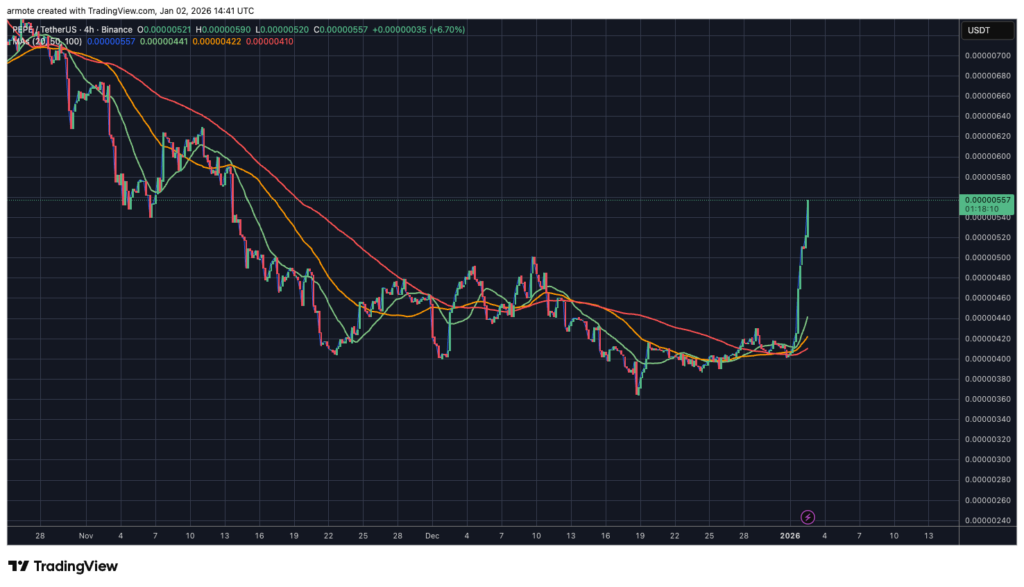
PEPE just ripped 26% higher on January 2, hitting $0.000005106 as trading volume exploded past $800 million.
That’s no thin pump—retail’s back, Robinhood holders sitting on 8.3% of supply, and a Hyperliquid whale named James Wynn dropped a bombshell prediction: $69 billion market cap by end-2026. If you’re trading memes, this is your wake-up call. Why now? New year FOMO meets bold calls in a market where BTC chills at $88k.
On-Chain Breakdown
PEPE’s ERC-20 on Ethereum. No fancy DeFi twist here—just pure meme liquidity. Volume spiked 370-400% in 24 hours, open interest jumped 82% to $446.5 million on derivatives. RSI hit 67, screaming bullish momentum after breaking $0.0000042 resistance.
Whales aren’t dumping. That official “We ride at dawn” tweet lit socials on fire—crypto Twitter’s buzzing. Supply’s fixed at 420.69 trillion tokens. If Wynn’s right, that’s $0.000164 per PEPE. Math checks out. But Ethereum gas? Still a killer for small trades.
Market Mayhem
Total crypto cap up 1.07% to $2.99T. BTC +1.21% at $88,765, dominance slipping to 59.22%—alts eating its lunch. PEPE led top gainers, outpacing Story (+25%) and Mog. Volumes hit $164B market-wide. No massive liqs reported, but meme sector OI surging means leveraged degens are in.
BTC’s post-halving year ended red for first time ever—down 6% in 2025 despite $126k ATH. ETFs pulled $348M, but macro liquidity rules now. PEPE doesn’t care—it’s riding retail hype while big boys consolidate.
Reactions Pour In
James Wynn, that Hyperliquid ser, straight-up said PEPE hits top meme status like SHIB did last cycle—if bull market holds. “We ride at dawn” from @pepe went viral. Community’s pumping: “PEPE to the moon” threads everywhere. No official team—it’s anon dev vibes.
Exchanges? Volumes exploding on Binance, MEXC. No rugs spotted. Traders on X calling for $0.000026 ATH retest. Sarcasm alert: Great timing for memes while BTC whales accumulate quietly. Holders care about flips, not halving myths.
But is this sustainable? Meme pumps fade fast.
Security Smarts for Degens
Don’t get rekt. PEPE’s been rugged before—no premine, but watch whale wallets. Use hardware for big bags; software wallets fine for sub-$1k. Check Etherscan for suspicious transfers. Avoid leverage over 5x—OI spike means liqs incoming on pullbacks.
Actionable: Set stops below $0.0000042. DCA if you believe Wynn. DYOR on Hyperliquid perps for leverage without CEX KYC. Phishing’s rampant post-pumps—double-check links. If you’re aping memes, keep it under 5% portfolio. Skin in the game matters, but don’t YOLO rent money.
Eyes on This
$0.000005 close today flips structure fully bullish. Watch BTC dominance drop—alts feast. Wynn’s $69B? Ballsy. If ETH L2s cut fees, PEPE volumes could 10x. Macro: Fed liquidity print January 2nd might juice risk assets.
Pullback to $0.0000045? Buy dip. Break $0.000006? Targets $0.00001 easy. Meme season back? You tell me. Trade smart—2026’s rewriting rules.
The post PEPE Explodes 26% in 24 Hours—James Wynn Calls $69B Market Cap by Year-End, Meme Degens Pile In appeared first on The Coins Post.
U.Today - IT, AI and Fintech Daily News for You Today
Despite the local price bounce, the bullish momentum on the market has faded way quicker than anticipated.
Veteran trader Peter Brandt has poured cold water on hopes of an imminent Bitcoin rally, saying current chart patterns provide no indication that a new bull market is close despite ongoing optimism among some market participants.
CurrencyCrypt

Chairman Tom Lee said ether’s outperformance versus the Nasdaq in July signals strengthening crypto fundamentals.

Michael Saylor’s Strategy sold 1,638 Bitcoin in its second-largest sale of the year to fund dividend payments and repurchase its preferred STRC stock.
Strategy sold 1,638 Bitcoin from July 27 through Sunday, marking its second-largest BTC sale of the year.
Strategy sold 1,638 Bitcoin at an average price of $63,957 for a total of $104.7 million, according to a Monday 8-K filing with the Securities and Exchange Commission. Of the proceeds, $52.4 million was used to fund dividend payments on Strategy’s STRC preferred stock, while another $52.3 million was used to repurchase STRC.
The company now holds 842,138 Bitcoin bought at an aggregate cost of $63.5 billion.
Read more
Crypto News Australia
- Coinkite published a security advisory and shipped emergency firmware on 31 July after a defect left Coldcard seeds with as little as 40 bits of entropy instead of the expected 128.
- Galaxy Research says about 1,367 BTC, roughly US$88.6 million, has been drained from 4,585 addresses, starting with 1,196 addresses emptied in 41 minutes on 30 July.
- Bitcoin transfers under 1 BTC reached 39,600 BTC on Friday, the highest daily total since November 2022, according to CryptoQuant.
CryptoQuant head of research Julio Moreno said 39,600 BTC changed hands in transfers under 1 BTC on Friday, the most in a day since 16 November 2022. “The Bitcoin plebs had not moved this amount of BTC in a day since the FTX collapse.”
Moreover, Coinkite acknowledged a flaw in how its Coldcard hardware wallets generated Bitcoin seeds and shipped emergency firmware for every affected model on 31 July, after researchers began mapping a series of thefts from Coldcard-generated addresses.
A firmware change made in March 2021 routed seed generation to a software fallback instead of the device’s hardware random number generator, Coinkite said in a technical post.
Seeds made on Mk2 and Mk3 devices without dice rolls ended up with roughly 40 bits of randomness, and those on the Mk4, Mk5 and Q with about 72 bits, against the 128 bits the devices were meant to produce.
That is few enough for keys to be guessed by brute force. The fallback code had sat in upstream software since May 2018. Security researchers at Block traced the fault to a production build setting.
Read more: Brother of Olympian Raygun Jailed Over $180,000 Linked to Alleged Crypto Scam
What Does Coinkite Say?
The advisory covers Mk2 and Mk3 firmware 4.0.1 through 4.1.9, Mk4 and Mk5 versions before 5.6.0, and the Q before 1.5.0Q. “Do not generate a new seed on any of these models until the update is installed,” it says. Updating does not repair a seed already created on the affected firmware, so owners have to generate a new one and move their coins.
According to Coinkite, two things can spare a wallet: feeding in at least 50 fair dice rolls during setup, or using a strong, unique BIP-39 passphrase.
Galaxy Research put the running tally at about 1,367 BTC, roughly US$88.6 million (AU$125.8 million), across 4,585 addresses, after 1,082 BTC left 1,196 addresses in a 41-minute sweep on 30 July.
Read more: Nansen CEO Bets AI Trading Agents Will Outnumber Human Traders Within Two Years
The post Bitcoin ‘Plebs’ Rush to Move Funds as Suspected Coldcard Hack Sparks Self-Custody Fears appeared first on Crypto News Australia.
- Blockchain analytics firm Lookonchain, citing Arkham data, said on Sunday that Trump Media moved 2,628 BTC worth about US$165 million to Crypto.com, leaving roughly 4,261 BTC.
- Trump Media’s last filed Bitcoin position was 9,542.16 BTC, down from a peak of 11,542.16 BTC on 30 September 2025 that cost the company about US$1.37 billion.
- The same filings disclose 4,260.73 BTC pledged as collateral against convertible notes and restricted from sale until no later than 29 May 2028.
Trump Media & Technology Group moved 2,628 Bitcoin (BTC) worth about US$165 million (AU$234.3 million) to Crypto.com on Sunday, blockchain analytics firm Lookonchain said, citing data from Arkham.
The company has not officially filed with the US Securities and Exchange Commission about the transfer, and its most recent filing of any kind is an 8-K dated 20 July.
Lookonchain puts the company’s remaining balance at about 4,261 BTC and its transfers over seven months at 7,281 BTC, roughly US$545 million (AU$773.9 million) at an average US$74,855 (AU$106,294) a coin.
It reported a similar movement of 2,650 BTC, worth about US$205 million (AU$291.1 million), to the same exchange on 22 May.
Read more: AI Stock Rout Spills Into Crypto as Bitcoin Slides and Liquidations Top $500 Million
Trump Media’s BTC Peak
Trump Media’s Bitcoin position peaked at 11,542.16 BTC on 30 September 2025, bought for about US$1.37 billion (AU$1.95 billion), or US$118,530 (AU$168,313) a coin. By 31 December, it was 9,542.16 BTC.
The company booked that 2,000 BTC reduction as a derecognition of US$174.83 million (AU$248.3 million) in carrying value, with a US$63.09 million (AU$89.6 million) loss attached. It did not use the word sale.
The position then sat still. Trump Media reported the same 9,542.16 BTC at 31 March 2026, carried at US$647.12 million (AU$918.9 million), with the only movement an unrealised loss of US$189.25 million (AU$268.7 million) as Bitcoin fell. It also holds 756 million Cronos tokens, worth US$52.95 million (AU$75.2 million) at that date.
Read more: Russia Issues International Wanted Notice for Telegram Founder Pavel Durov
The post Trump Media Sells Another $165M in Bitcoin as Holdings Shrink by 63% appeared first on Crypto News Australia.
CoinGeek
Tether's quarterly financial update faces criticism for changing key profit metrics, prompting renewed questions about transparency and performance.
The post Tether compares apples to oranges to claim Q2 ‘profit’ appeared first on CoinGeek.
Anthropic's book-scanning case shows why AI needs data provenance and blockchain-backed records to preserve trust in digital knowledge.
The post Anthropic burned the books?! appeared first on CoinGeek.
AMBCrypto
Ondo Finance deposited 4 million ONDO worth $1.56 million to Coinbase.
SHIB has started August in the red, but its rising burn rate could be signaling a bigger strategic play.
Decrypt
Scientists are using OnlyFans to help fund decades of marmot research, while unofficial memecoins inspired by the project have emerged on Solana.
Prosecutors say the former counterintelligence supervisor stole cryptocurrency from wallets tied to FBI investigations before asking ChatGPT how to invest the money and relocate to Europe.
CryptoSlate
Strategy's latest Bitcoin sale lifted its 2026 disposals to 5,258 BTC, the largest amount it has sold in any year since adopting the asset in 2020, as the company redirects capital toward supporting its preferred securities.
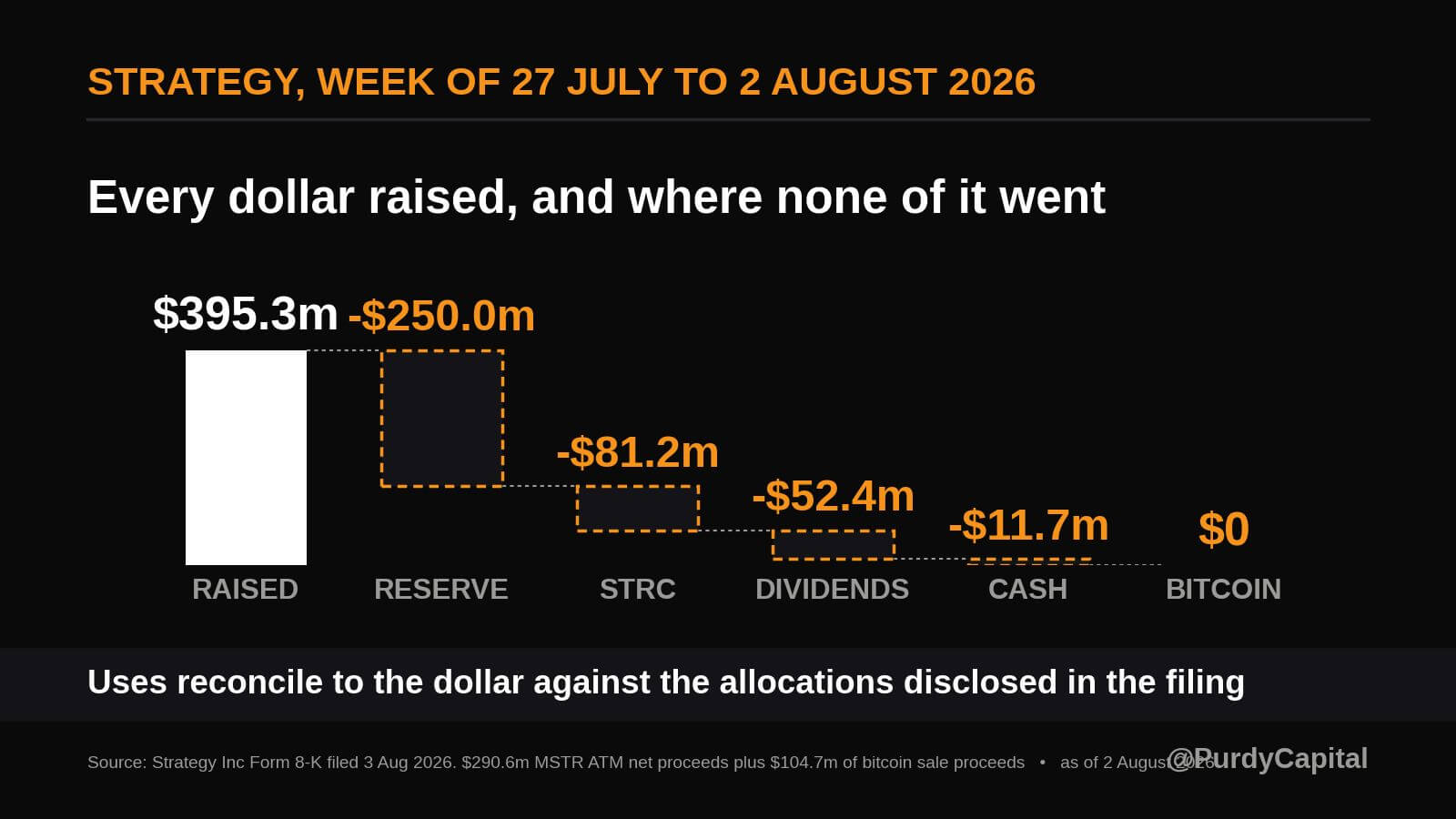
The company sold 1,638 BTC for $104.7 million between July 27 and Aug. 2 and issued about 3.01 million MSTR common shares for another $290.6 million, according to an Aug. 3 filing with the US Securities and Exchange Commission.
None of the nearly $395 million raised went toward new Bitcoin purchases. Instead, Strategy used the capital to fund preferred dividends, repurchase STRC shares and complete the expansion of its US dollar reserve to $4 billion.
The allocation extended its Bitcoin acquisition pause to six consecutive weeks, its longest since 2024.
STRC's discount forces Strategy to redirect capital
The most immediate obstacle to Strategy resuming Bitcoin purchases is STRC, a variable-rate preferred stock the company wants to establish as a repeatable funding source for its treasury.
When STRC trades near its $100 stated amount, Strategy can issue additional shares around par and deploy the proceeds across its capital structure, including toward Bitcoin purchases.
Trading at a sustained discount weakens that channel because new issuance would require either a lower sale price or a higher dividend yield to attract investors.
STRC has remained below par since May despite a dividend structure that allows Strategy to adjust the payout to support its market price. The company has responded by raising the annual dividend rate to 12% and repurchasing shares at a discount.
Last week, Strategy used $52.3 million from its Bitcoin sale and $28.9 million from its MSTR issuance to buy back 912,143 STRC shares for $81.2 million.
The transaction followed a $25 million repurchase the previous week, when the company acquired 288,930 shares at an average price of $86.53.
During the company's second-quarter earnings call, Strategy President and CEO Phong Le said buying STRC below par allows the company to retire future dividend obligations at a discount while strengthening demand as the shares move toward $100.
Strategy has now spent about $106.2 million on STRC repurchases since launching the program in July. It retains $893.8 million under its preferred-stock repurchase authorization, while a separate $1 billion authorization for MSTR common-share buybacks remains unused.
The company is targeting a return to par for STRC by September, with the pace of further purchases dependent on the stock's price and market liquidity.
Reaching that target would restore a financing channel that has become increasingly important to Strategy. The company raised $7.53 billion through its capital programs in 2026 through July 26 as preferred securities assumed a larger role in funding its balance sheet.
A $4 billion reserve protects preferred payments
Strategy also used last week's common-stock issuance to complete a rapid expansion of the cash reserve supporting its preferred dividends and debt interest.
Of the $290.6 million raised through MSTR sales, $250 million was transferred to the US dollar reserve, and $11.7 million was retained as cash.
The company had already increased the reserve from $2.55 billion at the end of June to $3.75 billion by July 26, primarily through common-stock issuance. The latest allocation lifted it to the $4 billion target.
Strategy estimated its annual preferred-dividend and debt-interest obligations at about $1.76 billion when it introduced its revised capital framework in June. At that rate, the reserve would cover approximately 27 months of payments.
Without further board approval, the funds can be used only to pay preferred dividends and interest on outstanding debt.
The reserve reduces the risk that Strategy would need to issue securities or sell Bitcoin under unfavorable market conditions merely to meet near-term obligations. It also provides preferred investors with a dedicated source of cash even when Bitcoin prices fall or access to capital markets deteriorates.
That protection, however, was largely financed through common-stock dilution.
Strategy issued about 3.01 million MSTR shares last week without purchasing additional Bitcoin. At the same time, its treasury declined by 1,638 BTC, reducing the amount of Bitcoin represented by each assumed diluted common share.
Longtime Bitcoin critic Peter Schiff said the transactions showed Strategy increasingly using Bitcoin sales and MSTR issuance to protect preferred investors.
The effect was visible in the company's Bitcoin-per-share performance measures. Strategy's year-to-date BTC Yield fell to 3.5%, compared with 13.3% in late May. Its quarter-to-date BTC Yield stood at -4.6%, while its BTC Gain declined by nearly 40,000 BTC, equivalent to about $2.4 billion at current prices.
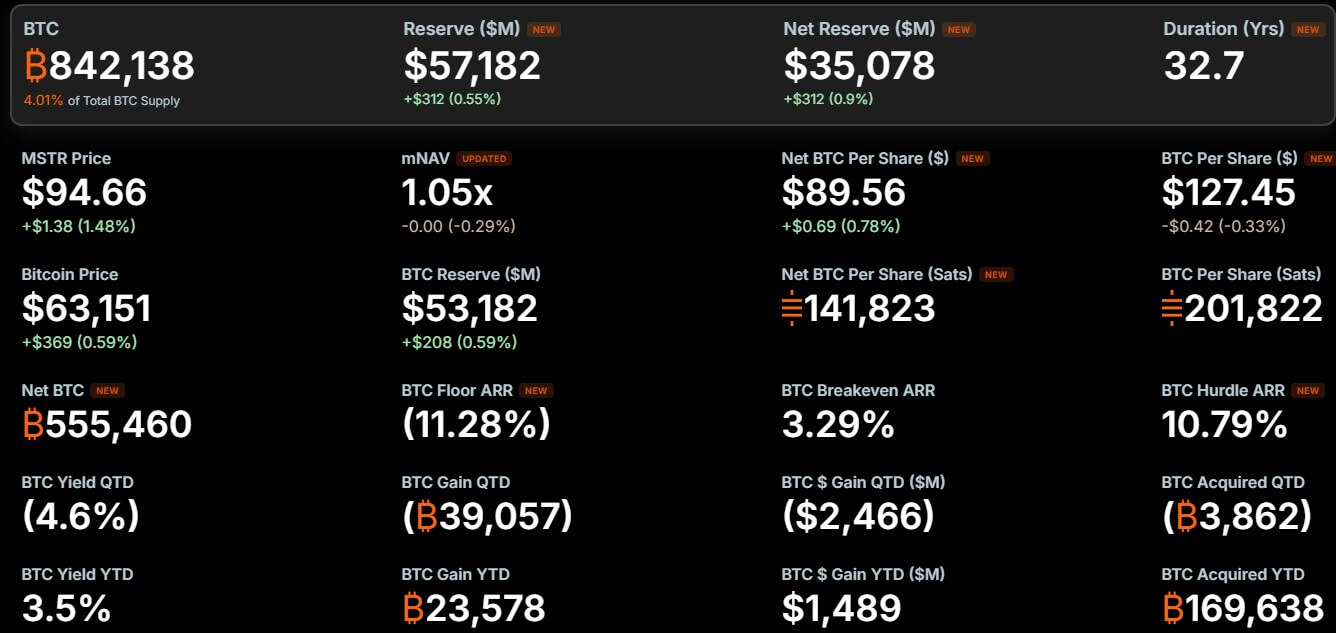
Strategy defines BTC Yield as the percentage change in Bitcoin held per assumed diluted share. BTC Gain converts that percentage change into an estimated number of Bitcoin.
The company cautions that neither measure represents shareholder returns, income, cash flow, or its ability to meet financial obligations.
The reserve therefore strengthens Strategy's ability to meet preferred and debt payments, but it shifts more of the financing burden onto MSTR shareholders whose exposure depends on Bitcoin accumulation outpacing dilution.
Bitcoin becomes an active source of liquidity
Strategy's aggressive Bitcoin selling this year shows that the asset is now being used as an operational source of liquidity for the securities business built around its treasury.
Indeed, the company sold 32 BTC in late May, 1,363 BTC on June 29 and 30, 2,225 BTC during the first five days of July, and another 1,638 BTC last week.
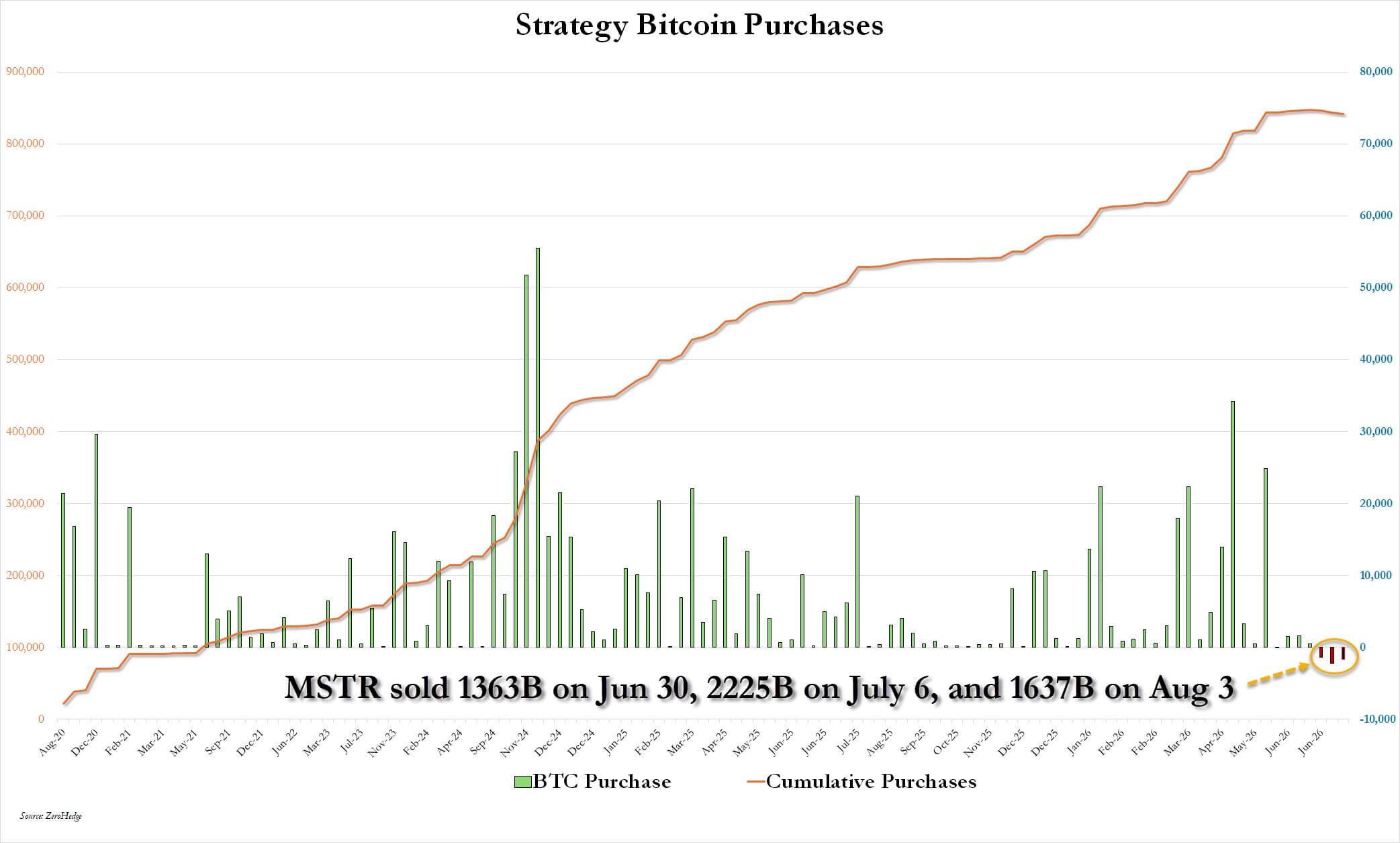
Bitcoin analyst Will Clemente said these transactions provided greater clarity about how Strategy intends to balance the interests of Bitcoin holders, MSTR shareholders and preferred investors.
The sales showed that management was prepared to move capital across its balance sheet rather than allow pressure in one security to weaken the wider financing structure, he said.
Strategy formalized that flexibility through its BTC Monetization Program. The framework authorizes the company to sell Bitcoin to increase its dollar reserve by as much as $1.25 billion, pay preferred dividends and debt interest, and finance repurchases of preferred or common shares.
Sales outside those purposes or beyond the approved limits would require additional board authorization.
Executive Chairman Michael Saylor has rejected claims that the program represented a breach of a formal promise to hold every Bitcoin indefinitely.
He said:
“Strategy announced its BTC Monetization Program on June 29, 31 days before our Q2 results, not after posting a loss. We have never had a ‘never sell’ policy. The program does not require any BTC sale, and we expect to remain a net buyer of Bitcoin over time.”
Strategy remains the largest corporate holder of Bitcoin, with 842,138 BTC representing just over 4% of the asset's maximum supply of 21 million coins.
The company acquired those holdings for $63.51 billion at an average price of $75,419. With Bitcoin trading near $62,633 as of press time, the treasury was worth approximately $52.7 billion, placing its market value about $10.8 billion below Strategy's aggregate acquisition cost.
That gap increases the cost of further monetization. Additional sales below the company's average purchase price would crystallize losses while reducing the Bitcoin supporting its expanding structure of common shares, preferred securities and recurring dividend obligations.
Saylor's expectation that Strategy will remain a net buyer therefore depends increasingly on whether restoring STRC to par allows the company to resume raising capital without continuing to dilute MSTR shareholders or draw down its Bitcoin treasury.
The post Strategy sells $395 million in Bitcoin and MSTR stock to buyback $81 million in STRC and build cash reserve to $4 billion appeared first on CryptoSlate.
Bitcoin miner Sphere 3D has up to $10.3 million of amended at-the-market stock-sale capacity for working capital, while its standing policy also permits mined Bitcoin sales for working capital or growth.
At the assumed $2.35 share price in its July 31 prospectus supplement, full use of the facility would add 4,382,978 common shares and expand the company’s basic share count by 50.9%.
That sale would lift basic shares outstanding from 8,619,150 to 13,002,128. The amended facility replaced Sphere 3D’s prior ATM prospectus. It is authorization, not a completed issuance: A.G.P. and Maxim are not required to sell a minimum amount, and the number of shares issued will depend on actual market prices.
The 4,382,978 new shares would represent about 33.7% of the resulting basic total, leaving shares already outstanding at about 66.3%. However, the filing’s base excludes stock options, restricted stock units and restricted stock awards, preferred-share conversion shares, warrants and shares reserved for future equity awards.
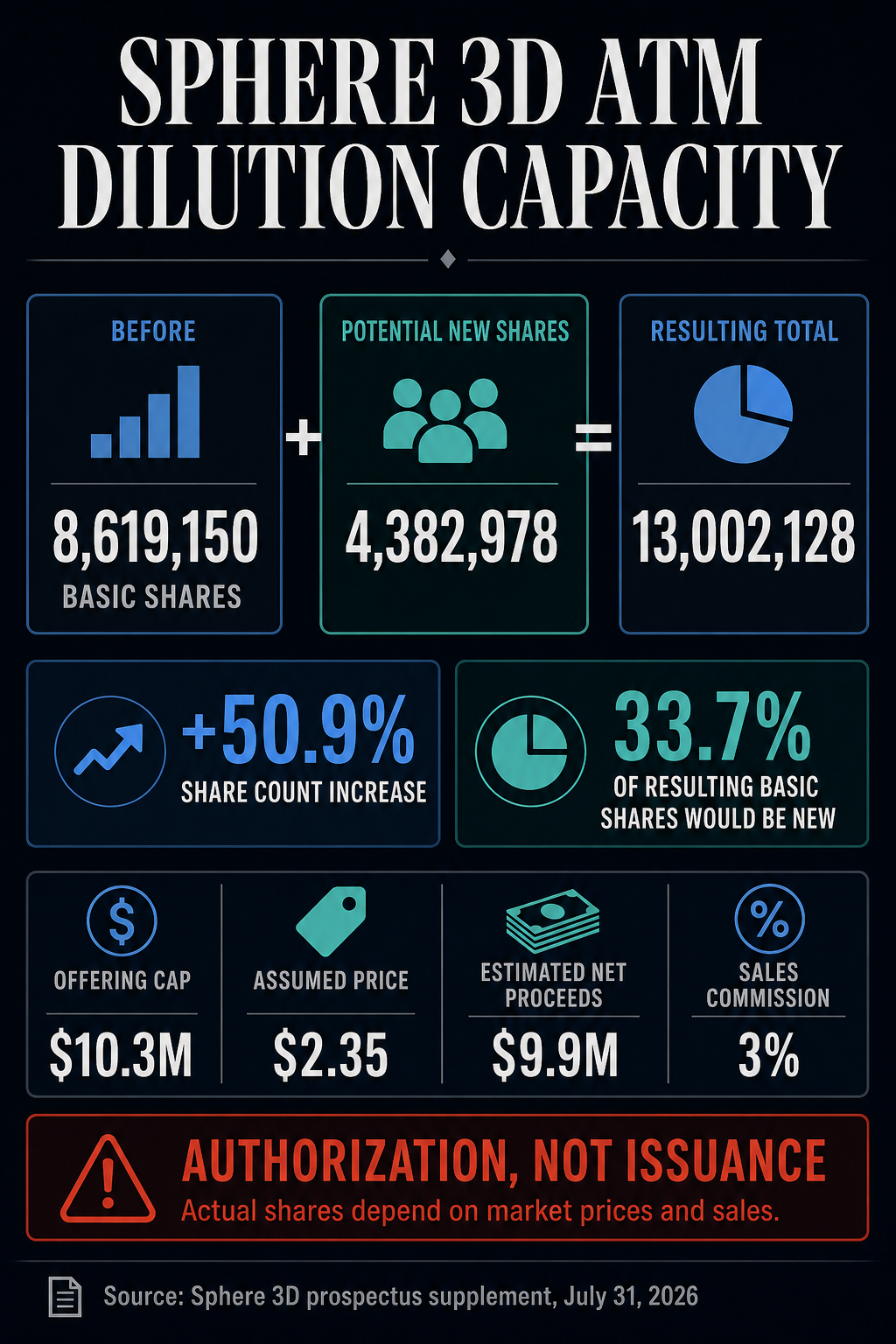
Sphere 3D estimates approximately $9.9 million of net proceeds if the full assumed offering is sold, after the 3% sales-agent commission and estimated offering expenses. Its prior program shows the equity channel has already been used: a companion Form 8-K says the company sold 2,172,789 shares under the superseded prospectus through July 30 for $5.13 million of gross proceeds. Those sales do not represent use of the amended facility.

Bitcoin remains a working-capital fallback
The latest available combined baseline predates the ATM amendment. Pro forma accounts as of March 31 showed $3.38 million of cash and $2.06 million of digital currencies for Sphere 3D and Cathedra combined. The figures model the merger as if it had occurred on that date and are not current post-closing balances.
Sphere 3D’s standalone quarterly accounts reported $3.15 million of cash and 26.2 BTC with a balance-sheet fair value of $1.79 million at March 31. The company generated $2.79 million of Bitcoin-sale proceeds during the quarter and said all dispositions funded operations.
Its July prospectus says management may continue selling mined Bitcoin when needed for working capital or growth; it describes a policy option and identifies no specific Bitcoin sale order.

That flexibility sits against documented liquidity pressure. Sphere 3D’s 2025 audit contained a going-concern explanatory paragraph, while Cathedra’s audit included a separate going-concern matter. Cathedra’s March 31 interim accounts also reported a C$4.35 million working-capital deficiency and C$1.17 million of net cash used in operating activities during the quarter.

As of an Aug. 3 check of Sphere 3D’s SEC submissions feed, no subsequent company filing had disclosed sales under the amended facility. That does not rule out trades that could be reported later.
Until a later disclosure, the measurable exposure is the filed capacity: up to 50.9% more basic shares, alongside a standing policy that treats Bitcoin as operating liquidity.
The post Facing a severe cash crunch, Bitcoin miner Sphere 3D quietly prepares to dilute its shareholders by a staggering 50% appeared first on CryptoSlate.
HTTP error 410 on https://magazine.cointelegraph.com/feed
Failed to fetch feed: https://magazine.cointelegraph.com/feed
Failed to fetch feed.
Bitcoin Magazine
Bitcoin Magazine

‘We’ll Get Through This Bear Market,’ Says CEO of Bitcoin Treasury Company Strategy
Bitcoin treasury company Strategy’s CEO Phong Le brushed aside concerns investors may have about the Nasdaq-listed company selling its stash.
Speaking on CNBC Monday, Le said that Strategy would continue doing what it’s always done, and outperform Bitcoin during the next bull run.
Strategy (MSTR) on Monday revealed that it had sold 1,638 Bitcoins for roughly $104.7 million, and bought back 912,143 shares of its preferred stock, STRC, for $81.2 million.
The firm’s stock is down nearly 40% year-to-date. It has shed nearly 80% of its value since it closed a record of nearly $474 in November 2024.
“I think Bitcoin is going through a bear cycle right now, and some of that is external macroeconomic,” Le said.
“We, as a company, went through this in 2022. We actively manage our capital structure, we rotate into Bitcoin, we sell Bitcoin when we need to, and we’ll continue to do so — and we’ll get through this bear market,” he added.
Strategy started buying Bitcoin in August 2020 as a way to generate better returns for its shareholders during the COVID-19 pandemic and hedge against inflation. It now has 842,138 coins worth $53.8 billion, making it the biggest corporate holder of the asset.
The idea is that investors can buy its shares to gain heightened exposure to the leading cryptocurrency without having to buy and hold digital coins themselves.
Strategy was aggressively buying Bitcoin week after week but hasn’t bought any in six weeks. In the company’s quarterly earnings last week, it posted a $8.22 billion loss for the second quarter of 2026.
Still, Le said the company’s current paper loss wasn’t important for the time being, and that next year, the company’s stock would soar again.
“We’re the J.P. Morgan of the crypto economy, so whether we sell 1,000 Bitcoin out of 840,000 to me is irrelevant to the conversation,” Le said.
“The conversation is what is our role in Bitcoin, and are we adding Bitcoin per share overall to our shareholders, and are we creating value? I think that’s an unequivocal yes.”
This post ‘We’ll Get Through This Bear Market,’ Says CEO of Bitcoin Treasury Company Strategy first appeared on Bitcoin Magazine and is written by Mathew Di Salvo.
Bitcoin Magazine

American Bitcoin Reports Quarterly Loss But Boosts Bitcoin Stash
Publicly traded Bitcoin treasury and mining company American Bitcoin’s stock jumped on Monday following news that the firm’s crypto holdings had increased.
The company (NASDAQ: ABTC) reported a second-quarter loss on Monday due to the decline in Bitcoin’s price but still added the largest cryptocurrency to its holdings, boosting its stack from 7,021 to 8,002 coins. Its stock was trading over 5% higher Monday afternoon in New York.
American Bitcoin now has a reserve worth over $510.6 million today’s prices, after the company’s “highest quarterly production on record.” It now has the 16th largest Bitcoin treasury, according to Bitcoin Treasuries data.
JUST IN:
— Bitcoin Magazine (@BitcoinMagazine) August 3, 2026Eric Trump’s ‘American Bitcoin’ increases their Bitcoin holdings by 300 BTC
They now hold 8,300 bitcoin!pic.twitter.com/LhaxsSkgad

“Our conviction in Bitcoin remains absolute, and our goal is simple: to deliver relentless growth, quarter after quarter, and build the preeminent American Bitcoin powerhouse for the long haul,” Eric Trump, American Bitcoin Co-Founder and Chief Strategy Officer, said.
American Bitcoin’s CEO Mike Ho added: “Despite Bitcoin headwinds in Q2, we stayed focused on what we can control: we delivered our highest quarterly production on record, grew our strategic reserve to over 8,000 Bitcoin, and strengthened the foundation of our business.”
“Looking ahead, we are focused on deepening that infrastructure advantage, strengthening our balance sheet position, and compounding Bitcoin per share so that the work we do today translates into durable value for our shareholders across market cycles,” Ho continued.
The company, a majority-owned subsidiary of Hut 8 Corp fronted by President Donald Trump’s sons, said that its focus on mining pushed quarterly production to a record, with about 932 Bitcoin mined in the second quarter.
Net loss in the second quarter of 2026 was $57.2 million, compared with a profit of $3.4 million in the same period last year.
Bitcoin miners have faced headwinds this year — and last — as the price of the largest cryptocurrency has dropped in price but the costs and difficulty to mine the coin have grown.
A lot of publicly traded Bitcoin miners have pivoted to the high-powered computing space, providing electricity to the artificial intelligence industry and in turn becoming a more attractive option for a broader swath of tech investors.
American Bitcoin is yet to make the pivot, instead focusing on minting the cryptocurrency and holding it on its balance sheet.
This post American Bitcoin Reports Quarterly Loss But Boosts Bitcoin Stash first appeared on Bitcoin Magazine and is written by Mathew Di Salvo.
Blockonomi
TLDR
- Oracle stock jumped 9.22% as Ontario hospitals expanded Oracle Health adoption.
- Baycrest joined Sunnybrook’s shared Oracle Health electronic record rollout.
- The project strengthens Oracle’s presence across complex hospital care systems.
- Sunnybrook will lead deployment, training, workflow design and staff changes.
- Oracle Health gains a major Ontario reference project across connected care.
Oracle (ORCL) stock jumped 9.22% to $141.85 as two Ontario hospitals advanced a shared Oracle Health electronic record project. The shares then gained 0.49% after hours to $142.60, extending the strong regular-session move. The partnership gives Oracle another major healthcare deployment across complex hospital and outpatient settings.
Oracle Corporation, ORCL
Baycrest Joins Sunnybrook’s Oracle Health Project
Baycrest Hospital will join Sunnybrook Health Sciences Centre in implementing a shared health information system. Oracle Health will provide the electronic health record platform supporting the joint deployment. Sunnybrook will lead the project after completing substantial planning for its own system replacement.
The rollout will cover Baycrest Hospital and its ambulatory clinics while building on Sunnybrook’s existing program. Both organizations will manage workflow design, training, staff engagement and operational changes together. Baycrest will contribute expertise in caring for older adults with complex medical and cognitive needs.
The platform will help care teams document, access and share clinical information across participating facilities. It will also connect hospital departments, clinics, physicians and staff through a common digital system. The design targets fewer information gaps when patients move between different services and care teams.
Shared Rollout Expands Oracle Health’s Ontario Presence
The agreement gives Oracle Health a visible reference project within two established Ontario healthcare organizations. Large hospital systems usually demand proven performance before replacing core clinical and administrative platforms. The joint rollout therefore strengthens Oracle’s record in large and specialized care environments.
Sunnybrook selected Oracle Health in 2025 to replace several separate information systems. The hospital expects one electronic record to improve coordination and information access across its facilities. Baycrest’s participation now extends that system into specialized hospital care and outpatient services.
The project also supports Ontario’s effort to improve digital links between healthcare providers. Shared systems limit duplicated records and give clinical teams quicker access to relevant patient information. Successful delivery will require training, aligned workflows and active participation from clinical and administrative teams.
Oracle Healthcare Strategy Gains Another Reference Project
Oracle targets healthcare organizations that need secure software for critical daily operations. Hospitals use electronic records for documentation, scheduling, coordination and clinical decisions. These systems often support long contracts because replacements require extensive planning, training and operational changes.
The Baycrest and Sunnybrook partnership provides another Canadian deployment for Oracle Health. It also shows Oracle’s ability to expand through shared projects involving multiple healthcare organizations. The model combines greater scale, common technical standards and broader information sharing across connected facilities.
Oracle shares ended the regular session with strong momentum before extending gains after the closing bell. Meanwhile, the Ontario project adds strategic context to Oracle’s continued healthcare expansion. The rollout strengthens Oracle’s presence in regulated sectors that depend on connected and reliable software.
The post Oracle (ORCL) Stock: Surges as Ontario Hospitals Expand Oracle Health Adoption appeared first on Blockonomi.
TLDR
- Micron stock rebounds as CXMT’s Beijing DRAM expansion raises supply concerns.
- CXMT could double capacity and intensify competition across global DRAM markets.
- New Chinese output may pressure memory prices, but the impact remains years away.
- Micron retains technology advantages despite CXMT’s aggressive factory expansion.
- CXMT’s growth threatens market share across standard DRAM products worldwide.
Micron Technology (MU) shares rose 0.87% to $830.21 after reversing a steep morning decline on Monday. Earlier selling followed reports that China’s CXMT may build another large DRAM factory in Beijing. The proposal raises concerns about future supply, pricing pressure, and stronger competition across the global memory market.
Micron Technology, Inc., MU
CXMT Plans Another Beijing DRAM Factory
ChangXin Memory Technologies is considering a second 12-inch wafer factory in Beijing’s Yizhuang technology district. The Chinese chipmaker has started early financing talks with local authorities and state-backed technology companies. CXMT seeks at least 60 million yuan, or about $8.9 million, in initial support.
The final financing structure, construction cost, and production target remain unsettled. A modern DRAM factory can cost more than $10 billion and require several years before production. Therefore, the proposed project will not change global memory supply or Micron’s position immediately.
CXMT already operates three 12-inch DRAM plants, including two facilities in Hefei and one in Beijing. Each facility can produce about 100,000 wafers monthly, giving CXMT significant domestic manufacturing capacity. Projects in Shanghai, Hefei, and Beijing could eventually lift monthly output above 600,000 wafers.
Micron Faces Longer-Term Supply Pressure
Samsung Electronics, SK Hynix, and Micron controlled almost 90% of the global DRAM market during the first quarter. CXMT remains much smaller, but its planned expansion could more than double current capacity. That growth could reduce leading producers’ market shares and increase competition across standard memory products.
Strong artificial intelligence spending has lifted memory demand and supported higher DRAM prices. Limited production capacity has also strengthened revenue prospects for Micron and its largest rivals. However, faster Chinese expansion could add supply and weaken pricing power across selected markets.
Micron still holds advantages in advanced manufacturing, product quality, and customer relationships. CXMT must improve production yields and deliver reliable advanced DRAM before challenging established suppliers. Consequently, capacity growth alone will not guarantee equal technology, margins, or market access.
CXMT Growth Could Reshape DRAM Competition
CXMT raised $8.6 billion through an initial public offering last month to support expansion. The company now holds China’s highest semiconductor valuation and seeks a larger global production role. That funding gives CXMT more resources for factories, equipment, research, and production development.
United States restrictions prevent CXMT from selling certain products directly into the American market. Even so, additional Chinese supply could ease shortages elsewhere and reshape international DRAM trade flows. Micron may face stronger competition where customers prioritize price, availability, and standard products.
The market reaction reflected future capacity concerns rather than an immediate threat to Micron’s operations. New factories require construction, equipment installation, testing, and customer qualification before meaningful shipments begin. Micron therefore retains a strong near-term position while CXMT develops its expansion plans.
The post Micron Technology (MU) Stock: Slightly Surge as CXMT Expansion Raises DRAM Market Concerns appeared first on Blockonomi.
news
For over 350 years (roughly since 1661 when the first banknotes appeared in Europe), the relationship between gold and paper money has shaped global finance.
The widely watched dot plot also showed that an eye-popping nine members pencilled in at least one rate hike this year, which was much more than expected.


