Crypto & Finance RSS
Cointelegraph.com News

As of Friday, 22 companies had filed objections as part of the joint venture’s proposed tokenized stock platform under the SEC’s innovation exemption.

The US tax agency is targeting faster resolutions and more flexible payment options for taxpayers voluntarily disclosing past tax violations under a planned program overhaul.
Bitcoinist.com
A revolutionary smart contract called NOX FUND has just launched on BNB Smart Chain, and it’s already paying users guaranteed 1.5% daily returns on USDT deposits with complete transparency and zero possibility of admin interference. Here’s why thousands are already depositing: the contract is completely ownerless, immutable, and professionally audited with no admin functions, no proxy patterns, and no pause mechanisms. What you see in the verified code is permanent, and that code guarantees 1.5% daily with mathematical certainty.
Start Earning Now | Join Community
The mechanics deliver immediate profits. Deposit USDT and start earning 1.5% every single day on your full principal. Claim those returns anytime starting from day one – there’s no waiting period for your first profits. Your principal locks for 45 days to ensure pool stability, but during that time you’re pulling pure daily profit. After 45 days, everything unlocks. Deposit 1,000 USDT today, claim 15 USDT tomorrow, and by day 45 you’ve earned 675 USDT in pure profit while your principal is ready to withdraw. Run that same capital through multiple cycles and the compound gains are exponential.
The contract at 0x433830E36585bdACC840E1caB419C4211bBf13f5 has been fully verified on BscScan, audited by HazeCrypto, and scanned by SolidityScan. Any developer can read the code and confirm: no Ownable inheritance, no delegatecall, no selfdestruct, zero admin privileges. The 1.5% daily rate is hardcoded into Solidity constants that literally cannot be modified by anyone. This isn’t a promise – it’s mathematics executing on an unstoppable blockchain.
The HazeCrypto audit specifically verified no hidden owner functions, no upgrade patterns, no pause mechanisms, no blacklists. All yields calculate deterministically on-chain using immutable constants. You’re trusting math and code, not a centralized team. The contract can’t be changed, paused, or upgraded ever. What you verify today exists forever.
Beyond guaranteed base yield, the referral system pays 20% in total commissions across your entire 7-level downline. When someone deposits using your link, you instantly earn 8% commission. When your referrals recruit others, you earn 4% from Level 2. The structure continues down to Level 7, creating true passive income as your network expands.
Real numbers: Refer 10 people who deposit 500 USDT each = 400 USDT instant commission (8% of 5,000). As those 10 people build networks, you earn 4% from every Level 2 deposit, 3% from Level 3, down through 0.5% at Level 7. Get 10 directs who each recruit 10 and you have 100 Level 2 positions. When those 100 deposit 200 USDT average, that’s 800 USDT in Level 2 commissions alone. Add Levels 3-7 and monthly referral income hits five figures.
Referral positions are permanent – once someone joins your downline, they stay forever earning you commissions on all future deposits and their network’s deposits. Early participants are establishing trees now that will generate passive income for years.
Smart participants create multiple smaller positions across different days instead of one large deposit. This generates rolling unlock dates – when position 1 hits day 45 and unlocks, position 2 has weeks remaining, position 3 is mid-cycle. Result: continuous principal access for redeployment rather than everything locking/unlocking simultaneously.
The platform calculator projects exact earnings timelines. Enter deposit amount and see daily ROI, cumulative earnings at each milestone, exact unlock timestamp, when position hits the 547.5% lifetime cap. Users track multiple positions, planning optimal withdrawal moments to extract principal right before cap and immediately redeploy into fresh positions that reset the counter.
All deposits flow into a shared contract balance. When users claim ROI or withdraw principal, funds come from this pool. New deposits feed the pool through the 5% protocol fee. Ongoing activity provides liquidity for existing users to claim returns. The mathematics are completely open – verify pool balance on-chain, see total deposits, track total withdrawals, calculate health metrics yourself.
Real-time statistics display on the dashboard pulled from contractInfo() function on-chain. TVL, active users, total ROI distributed, all metrics can’t be faked because they read immutable blockchain state. Users watch positions update live as epochs pass and ROI accumulates.
NOX FUND delivers guaranteed 1.5% daily USDT yields through completely immutable, professionally audited smart contract with zero admin control. Verified on BscScan, audited by HazeCrypto, already processing deposits and withdrawals flawlessly. Earn from base yield plus 20% referral commissions across 7 downline levels. Start in under 60 seconds – connect wallet, deposit USDT, earn tomorrow. Principal unlocks after 45 days with 67.5% profit already claimed.
Early participants are establishing networks generating passive income for years. TVL growing, community expanding globally, withdrawal success rates consistently high. The question isn’t whether it works – verified code and real users confirm it does. The question is whether you’ll participate while prime positioning is available, or watch others build networks and earn yields.
Contract: 0x433830E36585bdACC840E1caB419C4211bBf13f5 on BNB Smart Chain
Audit: https://hazecrypto.net/audit/Noxfund
Platform: https://nox.fund/
The code is immutable. The yields are guaranteed. The opportunity is now.
TL;DR: Archax has adopted Chainlink Data Streams to supply pricing information for GOVY, its tokenised US Treasury product, as it develops collateral use cases.
Putting Treasury bills on a blockchain is only the beginning. If an institution wants to borrow against them or use them as margin in an automated market, the software also needs reliable, timely information about their value.
That is the gap Archax is addressing with Chainlink. The regulated digital asset platform said it has adopted Chainlink Data Streams for GOVY, its continuously rolling tokenised US Treasury product. The aim is to supply pricing data to support lending, treasury management and other on-chain collateral applications.
GOVY is designed to provide exposure to short-dated US government bills, with the underlying securities held in regulated custody. Archax describes features including transfers between approved wallets and subscriptions or redemptions using supported stablecoins.
Those details matter because a tokenised security still needs rules around custody, eligibility and price discovery. A faster oracle feed cannot remove credit, liquidity or operational risk, and a proposed DeFi integration still has to be approved by individual markets. What it can do is make the underlying asset’s price usable by programmable financial systems. That is a practical step towards institutions treating tokenised Treasuries as working collateral, not simply a digital certificate.
Written by the News Desk and edited by Samuel Rae.
NewsBTC
TL;DR: US household inflation expectations rose in October while consumer sentiment barely changed. The readings add context ahead of the Federal Reserve’s October 27–28 meeting, without establishing a rate decision or a Bitcoin price direction.
American households expect prices to rise faster over both the next year and the longer run, according to the University of Michigan’s final October survey. For Bitcoin traders heading into another Federal Reserve decision, the release adds an inflation concern to an already important policy week.
The university’s October 23 results put year-ahead inflation expectations at 4.7%, up from 4.6% in September. Long-run expectations increased from 3.4% to 3.5%. Both measures rose for a second consecutive month and reached their highest readings since May.
Consumer sentiment was almost unchanged at 48.0, compared with 48.1 in September. Beneath that steady headline, the current-conditions index fell to 46.7 while the expectations index improved to 48.8. The university linked weaker conditions for buying durable goods to affordability concerns and higher interest rates.
A policy meeting with competing pressures
The Fed’s published calendar places its next meeting on October 27–28. Its most recent decision, on September 16, raised the federal funds target by a quarter of a percentage point to 3.75%–4.00%. That statement described inflation as elevated and reaffirmed the central bank’s 2% objective.
Michigan’s figures measure what households expect. They are separate from actual consumer-price inflation and from the Fed’s own projections. Comparing the survey’s percentages directly with the policy target would overlook differences in the measure and the time horizon.
The distinction does not make expectations irrelevant. In an earlier Fed explanation of the subject, then-Governor Adriana Kugler described longer-term expectations as a useful indication of monetary-policy credibility because they tend to respond less to short-lived price shocks.
The implication for crypto depends on the response
One plausible reading is that rising expectations make it harder for policymakers to sound comfortable about inflation. The weaker assessment of current conditions creates a competing concern: households are already feeling the effects of expensive credit and reduced purchasing power. Neither signal determines the committee’s decision by itself.
For Bitcoin and Ethereum, the transmission runs through financing conditions, the return available on cash and investors’ willingness to hold volatile assets. Higher expected inflation can strengthen the appeal of scarce assets in principle, while tighter monetary policy can work against speculative demand. Treating the survey as an automatic bullish or bearish signal misses that tension.
Dollar stablecoins illustrate another distinction: maintaining a dollar peg does not protect a holder from changes in that dollar’s purchasing power.
The immediate checkpoint is Wednesday’s policy announcement. Traders will have to judge the decision alongside the Fed’s explanation of inflation and growth, rather than infer an entire rate path from one household survey.
Written by the News Desk and edited by Samuel Rae.
TL;DR: Farside’s preliminary figures show US Bitcoin funds retaining a $301.2 million weekly inflow despite two days of withdrawals. Ether funds were down $220.7 million for the week; Friday’s tables still contained missing entries.
US spot Bitcoin funds gave back much of their early-week buying by Friday, leaving a smaller positive balance in the latest available data. The reversal makes the week’s total more informative than either the strong opening sessions or the withdrawals that followed.
Farside Investors’ table, checked on October 24, showed net outflows of $137.9 million for Friday after $635.6 million on Thursday. Together, those two sessions removed $773.5 million. Monday through Wednesday had attracted $1.0747 billion, leaving a provisional five-session inflow of $301.2 million.
Ether’s Friday inflow leaves the week underwater
Friday’s Bitcoin withdrawals were concentrated in BlackRock’s IBIT and Fidelity’s FBTC, at $110.3 million and $31.8 million respectively. Morgan Stanley’s MSBT recorded a $4.2 million inflow.
The Ether fund table showed a different balance. Friday’s reported inflow of $4.4 million followed a $110.6 million withdrawal on Thursday. Adding the five daily totals gives a provisional weekly outflow of $220.7 million. The small final-session gain therefore did little to offset the earlier redemptions.
Both calculations need a qualification: Farside still displayed a dash for VanEck’s Friday entry in each table when checked. The published totals should be treated as incomplete snapshots. A dash has not been converted into a confirmed zero in the underlying data, and subsequent updates could change the weekly figures.
Flows describe fund demand, with limits
The comparison suggests demand through these listed vehicles was more resilient for Bitcoin than Ethereum over this particular week. It does not establish who was buying, how long they intend to hold, or what happened across every other route into the crypto market.
The SEC’s general explanation of ETF mechanics distinguishes trading existing shares from creating or redeeming fund shares. Investors can trade with one another during a session without every transaction producing a corresponding change in the fund’s assets. Turnover and net flows answer different questions.
That distinction also matters when interpreting blockchain transfers. A transfer involving a custodian is not, on its own, a complete account of investors’ subscriptions and redemptions. Fund-flow data, share counts and custody movements need to be read in their own context.
For the next trading week, the useful question is whether fresh subscriptions can rebuild the demand lost in the last two sessions. A positive weekly balance leaves that possibility open, but the late reversal gives little support to treating institutional demand as a steady, one-directional buyer.
Written by the News Desk and edited by Samuel Rae.
CryptoPotato
Aside from the overall painful experience of having to endure another bitcoin leg down, these corrections are usually accompanied by Peter Schiff’s never-ending criticism and predictions about the doom and gloom of BTC and the entire industry.
Yesterday was no exception. BTC dumped to a 5-week low at $79,000, and the goldbug came out of his shell and warned that the cryptocurrency is going to $75,000. That’s not exactly what happened next.
Schiff’s Latest
Is it really a correction if Peter Schiff doesn’t lash out? As reported yesterday, the primary cryptocurrency dipped below $80,000 and slipped to just over $79,000 for the first time since September 18. The goldbug outlined on X that “Bitcoin is finally breaking down,” going even further by saying, “it’s hard to believe it’s held up this long.”
His ultimate prediction for the weekend was that the asset will inevitably dump to $75,000. He also predicted a “very long weekend for Bitcoiners, especially for ETF investors who can’t sell until Monday.”
Needless to say, that didn’t happen. At least for now. Instead, BTC rebounded swiftly, reclaimed the $80,000 level, and even touched $81,000. Although it was stopped there and has retreated slightly on Sunday morning, it still remains above $80,000 – or, $5,500 above Schiff’s weekend target.
Willy Woo was among the first to catch Schiff’s latest crash prediction and noted that he is “immensely valuable to the BTC community as a counter signal.”
Previous Schiff ‘Right’ Calls
Some of his earliest calls date back to 2018-2019. During the 2018 bear market, he predicted a crash to $750, which didn’t materialize. A year later, he said BTC would never reach $50,000. In 2021, he admitted that BTC could briefly tap $100,000, but said a permanent drop to zero was “inevitable.”
During the next major bear market in 2022, he doubled down on the idea that bitcoin won’t go back up to $50,000 as the asset had tumbled below $20,000. In 2024, he warned that the ETF launch would lead to no demand and a subsequent price crash. Just for reference, ETF investors have poured over $55 billion into the products. Oh, and BlackRock’s Bitcoin ETF far surpassed any gold products in its debut year.
In July this year, when bitcoin was struggling below $65,000, he said investors would regret not selling there. BTC exploded within a month.
The post Bitcoin Reclaims $80K Immediately After Peter Schiff Predicted a Crash to $75K appeared first on CryptoPotato.
A UAE-led international operation involving Interpol and law enforcement agencies from 30 countries identified more than $39 billion in fraud-linked funds and digital assets while thwarting well over 123 million online fraud attempts between July and September 2026.
The results point to the scale of cross-border digital crime, with authorities now working to recover the identified assets and disrupt networks using online platforms, financial services and cryptocurrencies.
Operation Confrontation Ghost Ran for Three Months Across 30 Countries
Led by the UAE’s Ministry of Interior, Operation Confrontation Ghost ran from July 1 to September 30 and went after AI-enabled fraud, financial scams run through digital platforms and online sextortion. WAM, the Emirates News Agency, stated that the operation stopped at least 123.71 million online fraud attempts worldwide.
Authorities arrested more than 960 suspects and raided 29 fraud centers. Investigators identified over 3,500 suspects and 15,500 victims, while 4,126 bank accounts were blocked and more than 570 social media accounts closed. Participants also exchanged over 9,000 pieces of intelligence.
Interpol and the Global Anti-Scam Alliance took part alongside 13 private companies, including Crypto.com, Meta, Mastercard and TikTok, WAM added. The operation also reported that tokenization technology helped secure more than four billion transactions each month, reducing fraud risks and strengthening data protection.
Results were presented at a UAE-organized side event during the 13th session of the Conference of the Parties to the UN Convention Against Transnational Organized Crime in Vienna.
Colonel Dana Al Marzouqi, director-general of the Interior Ministry’s International Affairs Bureau, explained that real-time intelligence sharing helps agencies spot suspicious activity faster and trace illicit money flows.
Dr. Monica Juma, executive director at the UN Office on Drugs and Crime, called the operation a model of international cooperation. She stressed that criminals’ use of AI, bank accounts and cryptocurrencies to move money and hide its origins demands better countermeasures and closer coordination.
US Authorities Have Been Chasing Similar Networks
As CryptoPotato reported previously, the US Justice Department’s Scam Center Strike Force seized Telegram-based scam marketplace Xinbi Guarantee in September and restrained about $52 million in crypto in a single day.
That lifted the total the Strike Force has restrained since its founding in November 2025 to roughly $938 million. Federal data reported crypto investment fraud losses at $8.65 billion in 2025, up 89% from 2023, although the FBI calls those figures “significantly underrepresented” because most fraud victims do not report.
The post UAE-Led Operation Flags $39B Linked to Crypto and Online Scams appeared first on CryptoPotato.
99Bitcoins
Swiss payments lender Arf said on Thursday, October 22, that it is partnering with Ripple to lend the RLUSD stablecoin to licensed cross-border payment companies on the XRP Ledger, giving them working capital while their payments settle. It was the week’s biggest XRP news, yet XRP fell 4% that day, and the onchain lending tools Arf plans to use still lack the validator votes to switch on.
XRP trades at $1.32 on Friday, down 0.9% in 24 hours and 17% in a month. So what does Arf actually bring, and when will the XRP Ledger’s lending protocol arrive?
Arf is bringing settlement liquidity to the @XRP Ledger.
Cross-border payments move trillions of dollars every year, but the capital needed to move that money often remains tied up across markets.
That’s why we’re partnering with @Ripple to bring RLUSD-powered settlement… pic.twitter.com/M9RQqdITse
— Arf (@arf_one) October 22, 2026
XRP News: What Is Arf Bringing to the XRP Ledger?
Short-term loans for payment companies. A remittance or card company sending money abroad often has to pay out at the destination before the sender’s funds arrive. That gap needs cash on hand in every market, and bank credit lines can take months to set up.
Arf’s settlement liquidity fills that gap with stablecoin loans that are usually repaid in one to five days, once the payment settles. The Zug-based firm, a Swiss-regulated financial institution, handles about $10 billion a year in settlement volume, with its capital turning over four times a month.
In the first phase, Arf will lend RLUSD directly on the XRP Ledger. The payment companies don’t need to touch a blockchain: Arf converts between fiat and stablecoins through its own bank accounts.
What Are XLS-65 and XLS-66, and When Do They Go Live?
They are the XRP Ledger’s native lending tools. XLS-65 creates Single Asset Vaults, where lenders pool one asset such as RLUSD. XLS-66, the Lending Protocol, lets that pooled money go out as fixed-term loans. Arf would keep doing the credit checks offchain, while the money itself would be held and lent onchain.
XRP Ledger commentator Vet called it “XRP Ledger powering cross-border payments with on-chain credit,” adding that it “fixes tradFi inefficiencies.”
Pay attention.
XRP Ledger powering cross border payments with on chain credit! It brings everything together and fixes tradFi inefficiencies.
What is the settlement liquidity Arf is bringing and what does this mean for XRP, XRP Ledger and RLUSD. Especially for XLS-66 and… https://t.co/gTp5p4dyIg pic.twitter.com/zbu3gFi2L2
— Vet (@Vet_X0) October 22, 2026
Neither tool is live yet. An amendment needs the support of 80% of trusted validators for two weeks before it activates. On the XRP Ledger amendment tracker, the Lending Protocol has 17 of 32 validator votes and Single Asset Vaults have 19, short of the 25 needed.
Until then, Arf will run the program with direct loans and move it onto the native protocol once XLS-65 and XLS-66 activate on mainnet.
How is this beneficial for XRP? RLUSD gains the most. It becomes the currency of every loan, from payout to repayment, and it needs the help of its home chain. RLUSD’s supply on the XRP Ledger has fallen to about $939.82 million from $1.05 billion a week ago, while its supply on Ethereum has grown to $1.46 billion.

For XRP, the link is indirect. Every XRP Ledger transaction pays a small fee in XRP, and accounts and objects such as vaults and loans lock up XRP reserves. Loans repaid every few days mean repeated transactions. But fees on the XRP Ledger are fractions of a cent, so the effect on demand stays small unless volumes become very large. Arf itself describes XRP’s role as supporting “the underlying network activity.”
DISCOVER: XRP Traders Cut Binance Leverage by a Quarter in Under a Month, and the Ones Left Are Leaning Long
XRP Price Analysis: Can XRP Hold $1.30?
The news didn’t lift the price. XRP climbed to $1.3992 on Wednesday, a one-week high, then dropped 4.1% on Thursday as Arf’s announcement went out, closing at $1.3094. It is now back near $1.32, inside the range it has traded in since mid-October.

Overhead, $1.332 to $1.353 is the first test, where the 4-hour 50 EMA meets the area Thursday’s drop broke through. Above that sits the bigger barrier: the daily 50 and 200 EMAs, bunched together between $1.371 and $1.374. XRP has closed both below every day since October 12, and Wednesday’s push above them failed within hours.
Below, $1.30 to $1.31 has held through Thursday and Friday. Losing it would put the October 18 low of $1.2562 back in play, the level that marked the bottom of this month’s slide. A daily close above $1.374 would open the way to Wednesday’s $1.3992 high and then $1.43.
The Arf deal is XRP news that matters beyond one day’s price: it gives the XRP Ledger a real lending customer with real payment volume. How much of that business actually runs onchain now depends on eight more validator votes.
EXPLORE: Best Crypto Presales With Asymmetric Upside in the Current Market
Follow 99Bitcoins on X For the Latest Market Updates and Subscribe on YouTube For Daily Expert Market Analysis.
The post Ripple Partner Arf Brings Its $10 Billion Payments Lending Business to the XRP Ledger appeared first on 99Bitcoins.
Bitcoin (BTC USD) is holding near $81,700 on Friday, October 23, after CryptoQuant CEO Ki Young Ju said retail traders have left Bitcoin futures markets. It’s the reverse of what his data showed at the 2025 top, after U.S. spot Bitcoin ETFs took in about $1 billion in three days. The price has lost $3,000 since Wednesday’s high. The buyers haven’t left.
The Bitcoin price is down 0.2% in 24 hours and 0.6% in a week. So does a quieter futures market point to a bottom, and which levels matter for BTC USD now?
Retail traders are gone from BTC futures markets, the exact opposite of what we saw at the top. https://t.co/7cdtVHsVgG pic.twitter.com/3O4lmbOfSd
— Ki Young Ju (@ki_young_ju) October 22, 2026
BTC USD: Why Does It Matter That Retail Left Futures?
Because crowded markets tend to top. CryptoQuant’s chart sorts futures trades by average order size. Through the summer of 2025, with BTC between $110,000 and $120,000 ahead of its October record, small retail orders dominated almost every day. Retail kept leading as the price slid into January.
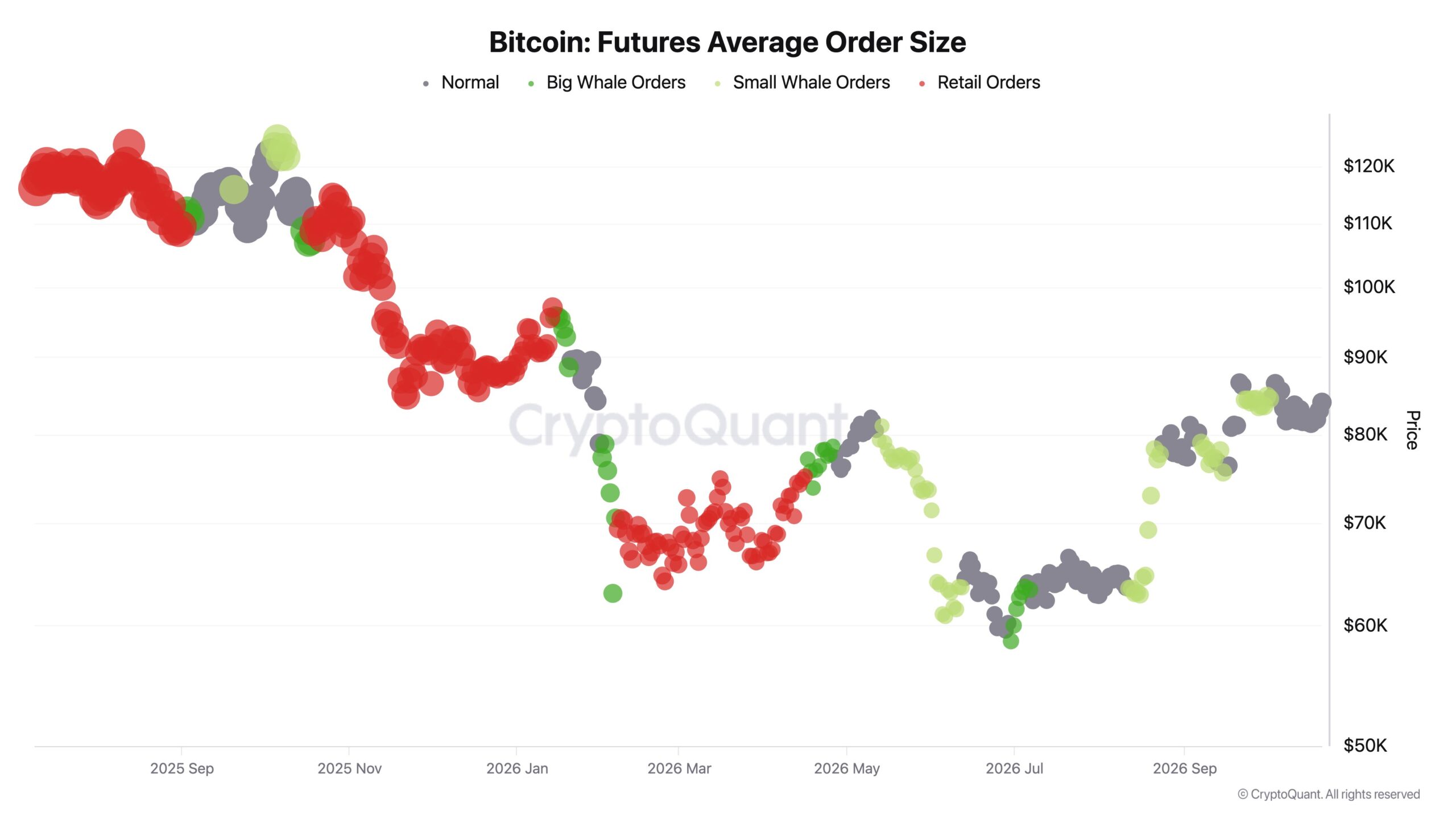
The picture is now reversed. Since May, no stretch has been led by retail. Large whale orders marked the July low near $58,000, and mid-sized whale orders drove the rally to $87,000 in September. October is mostly neutral, with whales still active.
That doesn’t mean the bottom is in. Retail also dominated from February to April 2026, when BTC was trading between $63,000 and $75,000, and BTC still fell to $58,000 by July. What it shows is that this market is less crowded with leveraged small traders, so there are fewer of them to liquidate on a drop.
Spot money agrees. U.S. spot Bitcoin ETFs took in about $1.07 billion from Monday to Wednesday, enough to turn October’s flows positive.
DISCOVER: Bitcoin ETFs Turn October Positive With $1 Billion in Three Days While ETH Funds Bleed $1 Billion
Are Bitcoin ETFs Still Buying?
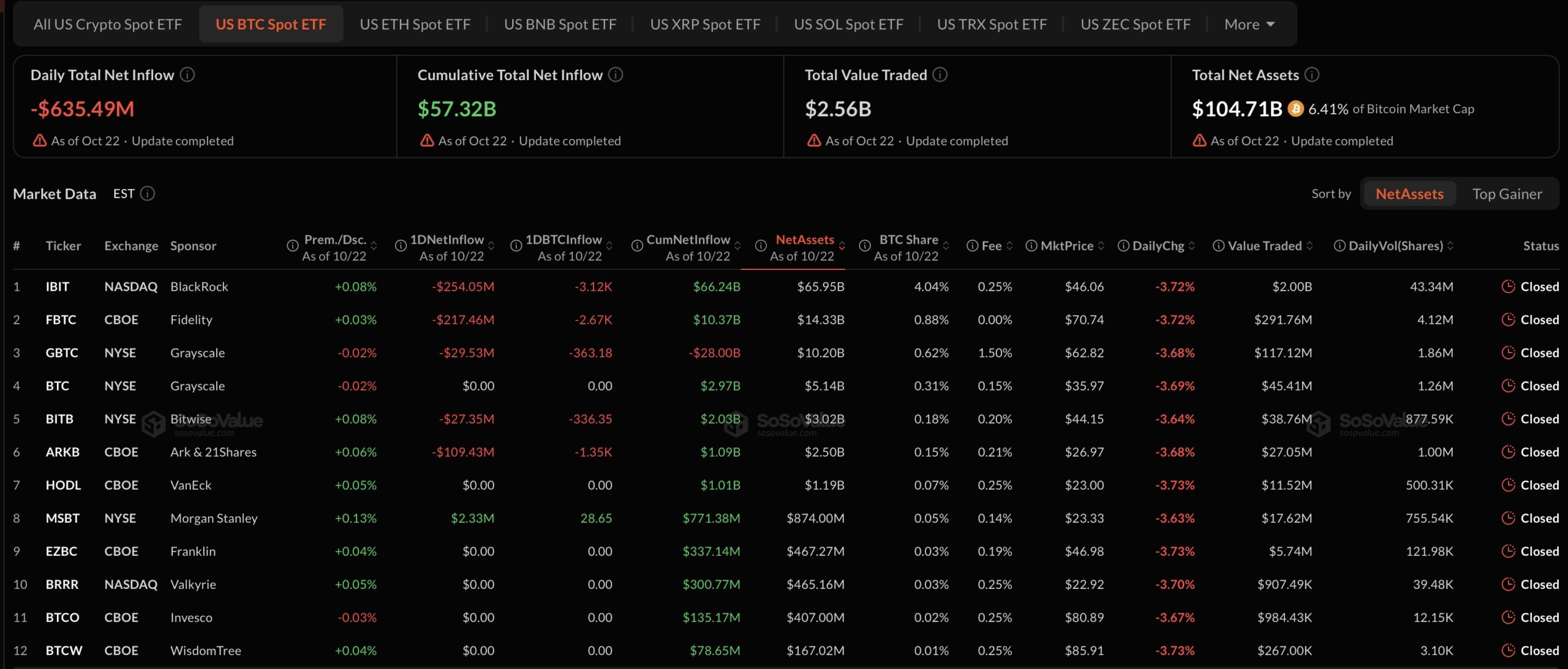
Yes, and in size. U.S. spot Bitcoin ETFs took in $526.7 million on Monday, $23.2 million on Tuesday and $524.8 million on Wednesday, about $1.07 billion in three sessions. That was enough to turn October’s flows positive.
BlackRock’s IBIT led again, with $235 million on Wednesday alone. Ethereum funds went the other way and kept bleeding money.
Put the two together, and the selling this week looks like short-term traders, not long-term money heading for the exit. ETF inflows of this size have come before past rallies.
DISCOVER: Bitcoin ETFs Turn October Positive With $1 Billion in Three Days While ETH Funds Bleed $1 Billion
BTC USD Price Analysis: Will $79,800 Hold?
BTC is back inside the range it has traded in since October 10, between roughly $79,800 and $84,300. Wednesday’s push to $84,898 above the top failed within a day.
The short-term damage is a broken trendline. Thursday’s drop cut through the rising line that had held every dip since the October 15 low, and BTC is now retesting it from below near $82,000.
Update: Still alive. Bitcoin doing a little bearish retest of trendline here and we can continue down to Seppuko land. https://t.co/KaNIrsKPE8 pic.twitter.com/iIObZMGEMt
— VikingXBT (@VikingXBT) October 23, 2026
Overhead, $82,000 to $82,850 is the first wall: the trendline, the swing highs and the 4-hour moving averages. A reclaim would put $84,300 back in play.
Below, $80,876 is the 50-day EMA, and $79,800, the October 15 low, is the floor of the whole range. A quick sweep under $79,800 that reverses would be a classic shakeout and the cleanest setup for a bounce. A daily close under it would point to the 200-day EMA near $76,200.
EXPLORE: J.P. Morgan Projects 10% a Year for Bitcoin: The Bank’s Own Bear Case Points to $25,000
One More Thing: Does the McRib Move Bitcoin?
Crypto Twitter has a less scientific indicator for Bitcoin. McDonald’s is bringing the McRib back “as early as 10/27,” and trader internbrah reminded more than 400,000 viewers that:
BTC historically goes up >2x after the McRib returns. Don’t fade the McRib.
The McRib is back on 10/27. BTC historically goes up >2x after the McRib returns. Don't fade the McRib.
Not financial advice. pic.twitter.com/RxBuzcVht5
— internbrah (@internbrah) October 22, 2026
We checked. Of the last seven McRib returns, BTC more than doubled within a year after two, in December 2020 and November 2023. After the November 2021 return, it topped out nine days later and lost two-thirds of its value. After the November 2025 return, it never traded higher.
| McRib return | BTC price | Best gain within 12 months |
|---|---|---|
| October 2019 | $8,246 | +49% |
| December 2020 | $19,201 | +252% |
| November 2021 | $61,004 | +11%, then −67% |
| October 2022 | $20,496 | +68% |
| November 2023 | $35,437 | +106% |
| December 2024 | $96,675 | +29% |
| November 2025 | $102,997 | none |
So the McRib is two for seven on doubling, which is about what you’d expect from a sandwich. For BTC USD, $79,800 still matters more than the menu.
EXPLORE: Best Crypto Presales With Asymmetric Upside in the Current Market
The post Retail Traders Have Left Bitcoin Futures: Can BTC USD Sweep $80,000 and Bounce? appeared first on 99Bitcoins.
Crypto Briefing
The rise of 24/7 trading on Robinhood Chain highlights a shift towards global, round-the-clock financial markets, challenging traditional exchanges.
The post Robinhood Chain sees 59% of stock token trading after Wall Street closes appeared first on Crypto Briefing.
The cancellation highlights the UK's grid limitations, potentially hindering its AI leadership ambitions and impacting future tech investments.
The post Microsoft cancels UK AI data center project due to power delays appeared first on Crypto Briefing.
crypto.news
Tether says 15 Bitcoin mining companies, including Bitmain and Canaan, will support its open-source MDK platform for equipment management and AI automation.
Bitcoin Core has changed its security disclosure policy after developers found that some vulnerabilities can be rediscovered with minimal effort, including a simple prompt to an AI model. The project’s October 22 policy update creates a faster route for those…
Coinlabz
The post What Is a Smart Contract and How Does It Work? appeared first on Coinlabz.
The post What is XEN Crypto? appeared first on Coinlabz.
BitRss - Crypto World News
Ethereum dropped 1.53% to $2,344.52 in the latest 24-hour session on Binance spot, trading below its 7-, 20-, and 50-day moving averages while Stochastic and RSI readings edge into or near oversold... (Read More)
ChainCatcher 消息,币安合约平台将上线 PREDICTUSDT 永续合约盘前交易,最高杠杆为 5 倍。
WordPress

บาคาร่า ทดลองเล่น เป็นทางเลือกสำหรับผู้ที่ต้องการทำความเข้าใจเกมผ่านการใช้งานจริงโดยไม่ต้องนำเงินจริงมาเสี่ยงในช่วงเริ่มต้น นอกจากเรียนรู้ว่าระบบทำงานอย่างไรแล้ว โหมดทดลองยังมีประโยชน์สำหรับสังเกตพฤติกรรมของตัวเอง เช่น การตัดสินใจเร็วเกินไป การเปลี่ยนตัวเลือกตามผลที่ผ่านมา หรือการเล่นต่อเนื่องโดยไม่ได้กำหนดเวลา ซึ่งเป็นสิ่งที่อ่านจากกติกาเพียงอย่างเดียวอาจมองเห็นได้ไม่ชัด
การทดลองยังสามารถใช้จำลองวิธีแบ่งงบและกำหนดระยะเวลาของแต่ละเซสชันได้ ผู้เล่นจึงไม่จำเป็นต้องมองโหมด Demo เป็นเครื่องมือค้นหา “สูตรชนะ” แต่ควรใช้เป็นพื้นที่ฝึกการตัดสินใจ ทำความเข้าใจความผันผวน และเรียนรู้ว่าผลที่ผ่านมาไม่ได้รับประกันผลในรอบถัดไป
บาคาร่า ทดลองเล่นช่วยให้สังเกตจังหวะการตัดสินใจของตัวเองได้อย่างไร
การใช้ระบบ บาคาร่าออนไลน์ ทดลองเล่น เพื่อสังเกตพฤติกรรมของตัวเองเป็นอีกวิธีที่ช่วยให้มือใหม่เรียนรู้ได้มากกว่าการจดจำกติกา ผู้เล่นสามารถสังเกตได้ว่าตนเองใช้เวลาตัดสินใจก่อนแต่ละรอบมากน้อยเพียงใด เปลี่ยนจาก Player ไป Banker เพราะข้อมูลอะไร หรือเปลี่ยนเพียงเพราะผลรอบก่อนหน้าไม่เป็นไปตามที่คาดหวัง
จุดที่ควรสังเกตเป็นพิเศษคือพฤติกรรมหลังเกิดผลแพ้ติดต่อกัน หากเริ่มเพิ่มยอดจำลอง เปลี่ยนโต๊ะ หรือกดเดิมพันเร็วขึ้นเพื่อหวังเอาคืน นั่นเป็นตัวอย่างของการตัดสินใจตามอารมณ์มากกว่าตามแผน โหมดทดลองช่วยให้เห็นพฤติกรรมเหล่านี้โดยไม่ต้องเสียเงินจริง
ผู้เล่นอาจทดลองกำหนดกติกาส่วนตัว เช่น ใช้ยอดเท่ากันทุกตา ไม่เปลี่ยนแผนเพราะผลระยะสั้น และหยุดเมื่อครบจำนวนรอบที่กำหนด จากนั้นจึงเปรียบเทียบว่าการตัดสินใจมีความเป็นระบบขึ้นหรือไม่
ทดลองบาคาร่าแบบไม่ใช้เงินจริง ช่วยให้เห็นข้อผิดพลาดอะไรได้บ้าง
แม้กติกาของ บาคาร่าออนไลน์ จะไม่ซับซ้อนมาก แต่ความผิดพลาดในการใช้งานสามารถเกิดขึ้นได้ โดยเฉพาะผู้ที่ยังไม่คุ้นกับตำแหน่งปุ่ม เวลาปิดรับเดิมพัน และการเลือกจำนวนชิป การทดลองโดยไม่ใช้เงินจริงช่วยให้สามารถทำผิดและเรียนรู้ได้โดยไม่มีความเสียหายทางการเงิน
ข้อผิดพลาดที่พบได้ เช่น เลือกจำนวนเงินผิด กด Player แทน Banker สับสนระหว่างยอดคงเหลือกับยอดที่กำลังเดิมพัน หรือพยายามเปลี่ยนตัวเลือกหลังหมดเวลา การเจอสถานการณ์เหล่านี้ในโหมดทดลองช่วยให้เข้าใจขั้นตอนของโต๊ะได้ดีขึ้นก่อนพิจารณาเล่นด้วยเงินจริง
| ข้อผิดพลาดที่ควรสังเกต | สิ่งที่ควรฝึก |
| เลือกชิปผิด | ตรวจยอดก่อนยืนยัน |
| กดฝั่งผิด | อ่านตำแหน่ง Player/Banker ให้ชัด |
| ตัดสินใจไม่ทัน | สังเกตเวลาปิดรับเดิมพัน |
| เพิ่มยอดหลังแพ้ | กลับไปใช้ยอดตามแผนเดิม |
| เล่นต่อโดยไม่รู้เวลา | กำหนดระยะเวลาไว้ก่อนเริ่ม |
การทดลองซ้ำควรมีเป้าหมายเพื่อให้ข้อผิดพลาดเหล่านี้ลดลง ไม่ใช่เพื่อหาลำดับการเดิมพันที่รับประกันกำไร เพราะผลของแต่ละรอบยังมีความไม่แน่นอน
บาคาร่า ทดลองเล่นช่วยให้เปรียบเทียบวิธีจัดการงบแต่ละแบบได้อย่างไร
โหมด บาคาร่าทดลองเล่น สามารถใช้จำลองการจัดการงบโดยไม่ต้องนำเงินจริงมาใช้ เช่น สมมติว่ามีงบ 500 บาท แล้วกำหนดว่าจะใช้ยอดคงที่ 10 หรือ 20 บาทต่อรอบ จากนั้นดูว่ารูปแบบดังกล่าวทำให้ควบคุมจำนวนรอบและติดตามยอดได้ง่ายเพียงใด
อีกวิธีคือแบ่งงบจำลองออกเป็นหลายช่วง เช่น กำหนดงบสำหรับหนึ่งเซสชันแยกจากยอดทั้งหมด และหยุดเมื่อถึงขอบเขตที่ตั้งไว้ วิธีนี้ช่วยให้เห็นความแตกต่างระหว่าง “มีเงินเหลือจึงเล่นต่อ” กับ “หยุดตามแผนแม้ยังมีเครดิตเหลือ”
อย่างไรก็ตาม ผลตอบแทนจากการทดลองหนึ่งครั้งไม่ควรถูกนำไปสรุปว่าวิธีจัดการเงินแบบนั้นสามารถสร้างกำไรในระยะยาวได้ จุดประสงค์ของการทดลองควรอยู่ที่การค้นหารูปแบบที่ช่วยควบคุมยอดและวินัยได้ง่าย ไม่ใช่การเลือกแผนจากเซสชันที่บังเอิญได้ผลดี
โหมดทดลองบาคาร่าเหมาะกับการฝึกกำหนดเวลาเล่นแบบไหน
การกำหนดเวลาเป็นสิ่งที่สามารถฝึกได้ผ่าน บาคาร่า Demo โดยผู้เล่นอาจเริ่มจากเซสชันสั้น ๆ เช่น กำหนดจำนวนรอบหรือช่วงเวลาล่วงหน้า แล้วหยุดทันทีเมื่อครบขอบเขต วิธีนี้ช่วยสร้างความคุ้นเคยกับการหยุดตามแผน แทนที่จะปล่อยให้ผลของเกมเป็นตัวกำหนดว่าจะเล่นต่ออีกนานแค่ไหน
สำหรับโต๊ะที่ดำเนินเกมเร็ว จำนวนรอบสามารถสะสมได้มากในเวลาไม่นาน จึงควรทดลองทั้งการกำหนด “เวลา” และ “จำนวนรอบ” เพื่อดูว่าวิธีใดติดตามได้ง่ายกว่า หากพบว่ามักลืมเวลาเมื่อเล่นต่อเนื่อง อาจใช้ตัวจับเวลาหรือพักเป็นช่วง ๆ ช่วยเตือน
การฝึกหยุดเมื่อกำลังชนะก็มีความสำคัญเช่นเดียวกับการหยุดเมื่อแพ้ เพราะเป้าหมายคือการควบคุมระยะเวลาตามแผน ไม่ใช่รอจนกว่าจะเกิดผลลัพธ์ที่ต้องการ
ควรใช้โหมดทดลองนานแค่ไหนก่อนตัดสินใจว่าเข้าใจระบบแล้ว
ไม่มีจำนวนรอบตายตัวที่บอกว่าผู้เล่นเข้าใจ บาคาร่า ทดลองเล่น แล้ว เพราะแต่ละคนใช้เวลาเรียนรู้ต่างกัน วิธีประเมินที่เหมาะสมกว่าคือดูว่าสามารถใช้งานระบบได้โดยไม่สับสนและเข้าใจผลของการตัดสินใจของตนเองหรือไม่
ก่อนพิจารณาเปลี่ยนจาก Demo ที่จะเล่น บาคาร่าบนมือถือ ได้นั้น ผู้เล่นควรสามารถแยกตัวเลือกเดิมพันได้ เข้าใจเวลาของแต่ละรอบ เลือกจำนวนเงินโดยไม่กดผิด กำหนดงบจำลอง และหยุดตามเวลาที่วางไว้ได้ นอกจากนี้ควรเข้าใจด้วยว่าผลที่เกิดในโหมดทดลองไม่สามารถใช้ทำนายว่าเมื่อเล่นเงินจริงจะได้ผลเหมือนกัน
หากยังพบว่าตนเองเพิ่มยอดตามอารมณ์ เล่นต่อหลังถึงขอบเขต หรือพยายามหาสูตรจากผลย้อนหลัง การทดลองต่อโดยไม่ใช้เงินจริงอาจเหมาะสมกว่า และไม่มีความจำเป็นต้องเปลี่ยนไปใช้เงินจริงเพียงเพราะเล่น Demo มาครบจำนวนวันที่กำหนด
โดยสรุป บาคาร่า ทดลองเล่น มีประโยชน์มากที่สุดเมื่อใช้เป็นพื้นที่เรียนรู้พฤติกรรม ฝึกจัดการงบ และสร้างความคุ้นเคยกับการหยุดตามแผน มากกว่าการใช้เพื่อค้นหาระบบที่อ้างว่าสามารถชนะได้แน่นอน การทดลองโดยไม่ใช้เงินจริงยังเป็นทางเลือกที่มีความเสี่ยงทางการเงินต่ำกว่าสำหรับผู้ที่ต้องการเรียนรู้เกมเท่านั้น.
The post บาคาร่า ทดลองเล่น เว็บออนไลน์ฝึกกติกา พร้อมทดลองโต๊ะหลายรูปแบบ appeared first on WordPress.

บาคาร่า มือถือ เว็บตรงสำหรับผู้เล่นที่ต้องการสลับค่ายผ่านสมาร์ตโฟน
The post บาคาร่า มือถือ เว็บตรงสลับค่ายง่าย รองรับ Live และทุกเครือข่าย appeared first on WordPress.
cURL error on https://bitcoinik.com/feed: Could not resolve host: bitcoinik.com
Failed to fetch feed: https://bitcoinik.com/feed
Failed to fetch feed.
Crypto News Alerts: Bitcoin, Ethereum & Cryptocurrency News
Ledger announced the Ledger Atom on 15 October 2026 at its Op3n event in Paris. The Ledger Atom is a new device from Ledger that runs everyday Android apps and signs crypto transactions in a separate secure mode. The Founders Edition costs $849, and it will increase to $899 after launch. It ships in summer 2027, pending certification.
On October 15, with the help of independent security researchers, we found a vulnerability affecting one of the integrations used on the ChangeNOW website. The vulnerability has now been fixed.
The Coins Post
Caroline Crenshaw’s departure from the SEC on January 2 marks a turning point for crypto regulation in Washington. The longtime cryptocurrency skeptic’s exit leaves the commission operating under a 3-0 Republican majority—a historic shift that clears the way for Paul Atkins’ pro-innovation agenda to move forward without meaningful internal opposition.
What Changed at the SEC
Crenshaw spent over a decade at SEC agency, consistently raising concerns about cryptocurrencies, digital assets and investor protection.
Her exit coincides with the broader regulatory reorganization under the Trump administration, which has explicitly positioned itself to make the U.S. the “crypto capital of the world.”
The commission now operates with fewer members than authorized, as Trump hasn’t yet filled the vacant seats—a strategic pause that effectively gives the Republican-majority commissioners free rein on policy.
Why This Matters Right Now
The timing couldn’t be sharper. SEC Chair Paul Atkins has already signaled plans to introduce an “innovation exemption” that would let crypto startups test new products under lighter regulatory requirements, provided they meet basic consumer protections. [3][7] That proposal was expected within 30 days of December 2, meaning it could arrive any moment. With Crenshaw gone, there’s no institutional voice pushing back on the exemption’s scope or implementation details.
The broader regulatory picture is also shifting. The Senate is scheduled to hold hearings in January on the CLARITY Act—landmark legislation designed to end years of turf warfare between the SEC and CFTC by clearly dividing jurisdiction over different crypto products. [3][7] White House crypto adviser David Sacks said in December the bill is “closer to passage than at any point in the past.” [3] These aren’t minor procedural tweaks. They represent a fundamental reordering of how Washington approaches digital assets.
What’s Next
The real action starts immediately. Watch for the innovation exemption announcement—it could drop with minimal fanfare. Then track the Senate hearings on CLARITY in January. If that bill moves to a floor vote and passes, the crypto industry will have concrete answers about regulatory jurisdiction for the first time in years. Markets have been pricing in regulatory clarity for months. Crenshaw’s departure removes one of the last obstacles to delivering on it.
The post SEC’s Pro-Crypto Shift Accelerates as Key Skeptic Crenshaw Exits appeared first on The Coins Post.
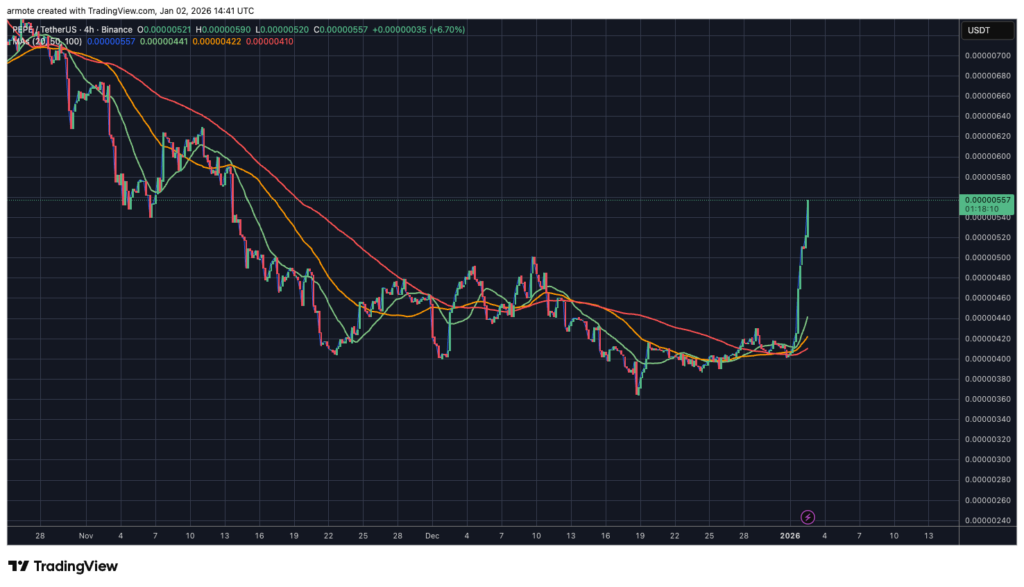
PEPE just ripped 26% higher on January 2, hitting $0.000005106 as trading volume exploded past $800 million.
That’s no thin pump—retail’s back, Robinhood holders sitting on 8.3% of supply, and a Hyperliquid whale named James Wynn dropped a bombshell prediction: $69 billion market cap by end-2026. If you’re trading memes, this is your wake-up call. Why now? New year FOMO meets bold calls in a market where BTC chills at $88k.
On-Chain Breakdown
PEPE’s ERC-20 on Ethereum. No fancy DeFi twist here—just pure meme liquidity. Volume spiked 370-400% in 24 hours, open interest jumped 82% to $446.5 million on derivatives. RSI hit 67, screaming bullish momentum after breaking $0.0000042 resistance.
Whales aren’t dumping. That official “We ride at dawn” tweet lit socials on fire—crypto Twitter’s buzzing. Supply’s fixed at 420.69 trillion tokens. If Wynn’s right, that’s $0.000164 per PEPE. Math checks out. But Ethereum gas? Still a killer for small trades.
Market Mayhem
Total crypto cap up 1.07% to $2.99T. BTC +1.21% at $88,765, dominance slipping to 59.22%—alts eating its lunch. PEPE led top gainers, outpacing Story (+25%) and Mog. Volumes hit $164B market-wide. No massive liqs reported, but meme sector OI surging means leveraged degens are in.
BTC’s post-halving year ended red for first time ever—down 6% in 2025 despite $126k ATH. ETFs pulled $348M, but macro liquidity rules now. PEPE doesn’t care—it’s riding retail hype while big boys consolidate.
Reactions Pour In
James Wynn, that Hyperliquid ser, straight-up said PEPE hits top meme status like SHIB did last cycle—if bull market holds. “We ride at dawn” from @pepe went viral. Community’s pumping: “PEPE to the moon” threads everywhere. No official team—it’s anon dev vibes.
Exchanges? Volumes exploding on Binance, MEXC. No rugs spotted. Traders on X calling for $0.000026 ATH retest. Sarcasm alert: Great timing for memes while BTC whales accumulate quietly. Holders care about flips, not halving myths.
But is this sustainable? Meme pumps fade fast.
Security Smarts for Degens
Don’t get rekt. PEPE’s been rugged before—no premine, but watch whale wallets. Use hardware for big bags; software wallets fine for sub-$1k. Check Etherscan for suspicious transfers. Avoid leverage over 5x—OI spike means liqs incoming on pullbacks.
Actionable: Set stops below $0.0000042. DCA if you believe Wynn. DYOR on Hyperliquid perps for leverage without CEX KYC. Phishing’s rampant post-pumps—double-check links. If you’re aping memes, keep it under 5% portfolio. Skin in the game matters, but don’t YOLO rent money.
Eyes on This
$0.000005 close today flips structure fully bullish. Watch BTC dominance drop—alts feast. Wynn’s $69B? Ballsy. If ETH L2s cut fees, PEPE volumes could 10x. Macro: Fed liquidity print January 2nd might juice risk assets.
Pullback to $0.0000045? Buy dip. Break $0.000006? Targets $0.00001 easy. Meme season back? You tell me. Trade smart—2026’s rewriting rules.
The post PEPE Explodes 26% in 24 Hours—James Wynn Calls $69B Market Cap by Year-End, Meme Degens Pile In appeared first on The Coins Post.
U.Today - IT, AI and Fintech Daily News for You Today
Veteran Bitcoin critic Peter Schiff has warned of a potential plunge to $75,000 after the world's largest cryptocurrency crashed below $80,000 amid a massive market sell-off.
Shiba Inu exchange activity sees a sudden reversal into bullish territory as surging demand from traders fades selling pressure.
CurrencyCrypt

Seven more issuers have opted out of being listed on the planned tokenized stock venue under the SEC’s framework, bringing its disclosed objection count to 16.


The April 1 hack caused about $295 million in losses and was later attributed to a North Korean threat group in a Mandiant investigation.
A wallet linked to the Drift Protocol hack sent about $61 million in Ether (ETH) to Tornado Cash, a service that obscures transaction trails.
The wallet deposited 25,700 ETH to the cryptocurrency mixer over two hours on Tuesday after two months of inactivity, blockchain analytics platform Lookonchain said in an X post.
The exploiter’s addresses held about 81,454 Ether, worth roughly $194 million, according to Arkham. Crypto mixers pool funds from multiple addresses and obscure fund trails, making tracing harder.
Read more
Crypto News Australia
- Cloudflare chief executive Matthew Prince said exploit attempts climbed from thousands before disclosure to millions after it.
- The PHP Foundation said a 2024 audit first surfaced one of the flaws and that work on a fix stalled for months.
- SlowMist told crypto firms to upgrade, and Australia’s cyber agency issued a critical alert on the flaws.
Hackers made millions of attempts to exploit two critical flaws in PHP, the programming language behind much of the web, after its developers released fixes on Wednesday, according to Cloudflare.
“In the 10 hours before it was publicly announced, across the network we saw thousands of attempts to exploit it. That jumped to tens of thousands in the 45 minutes post announcement, hundreds of thousands within 2 hours, and millions now,” Cloudflare chief executive Matthew Prince wrote on X late on Wednesday.
The flaws, tracked as CVE-2026-109618 and CVE-2026-109619, carry a severity score of 9.2 out of 10. Both affect all web servers running PHP 5.4 or later, according to Cloudflare. Crafted web requests may let an attacker crash a server, expose sensitive data or run their own code.
Cloudflare said PHP is used by almost 70% of websites, including those built on WordPress and Magento.
A Fix That Stalled Since 2024
The PHP Foundation said a contracted core developer found the first signs of the memory problem behind one of the flaws in 2024. That came during PHP’s first external security audit in years, carried out by Quarkslab.
The security team drew up several competing fixes, but each one carried trade-offs. Its work then stalled and restarted for months, the foundation said in a blog post on Wednesday.
We won’t pretend otherwise: the delay was a structural failure, caused by both the security team’s decision process and its lack of resources.
Security firm Calif reported a remote code execution flaw with the same root cause on 11 August. After the vulnerability IDs leaked online, PHP brought its release forward a day to 21 October.
The foundation said AI-assisted research now finds bugs faster than ever, for defenders and attackers alike. Crypto security experts say AI tooling is speeding up both smart contract hacks and bug hunts.
Read more: Switzerland Approves First Retail Bitcoin ETF Under Domestic Fund Rules
Crypto Platforms Told to Patch
Blockchain security firm SlowMist said its MistEye system had scanned PHP-related assets across the crypto industry. It urged platforms, DeFi projects and wallet providers to assess their risk and install the patched versions.
BNB Chain executive director of growth Nina Rong posted that the network does not use PHP in its technology stack, and Binance founder Changpeng Zhao posted a warning on X for anyone browsing.
In April, attackers hijacked CoW Swap’s front-end domain and drained at least US$1 million (AU$1.43 million) from users.
The Australian Signals Directorate’s cyber centre rated its PHP alert critical. It said it was not aware of successful active exploitation within Australia. The agency’s own website, cyber.gov.au, was among the government sites that reported outages.
Read also: BlackRock Makes a Splash with New Bitcoin ETF Filing as IBIT Takes in US$665M
The post Millions of Cyberattack Attempts Target Websites as Critical PHP Flaws Threaten Crypto Platforms appeared first on Crypto News Australia.
- Bitcoin dropped to US$80,958 before recovering to US$81,626, while Altcoins also faced headwinds.
- Global equities weakened amid concerns over AI spending, rising oil prices and geopolitical tensions, with the Nasdaq falling 2.6% and Asian markets also declining.
- US spot Bitcoin ETFs recorded approximately US$635.6 million in net outflows on Thursday, reversing nearly 60% of the week’s earlier inflows.
- Despite heavy withdrawals from BlackRock’s IBIT and Fidelity’s FBTC, Bitcoin ETFs remained positive for the week with around US$439 million in net inflows.
After topping out at US$84,835 (AU$121,066) in early trading yesterday, Bitcoin (BTC) is clinging to the US$80K (AU$114K) mark. Earlier this morning, Australian time, it dropped as low as US$80,958 (AU$115,533), according to data from CoinMarketCap.
At the time of writing, BTC trades at US$81,626 (AU$116,499), a drop of 1.36% over the past 24 hours and 3.78% from yesterday’s high.
Altcoins have also come under pressure, with DeFi tokens such as Curve DAO and ether.fi losing over 7% in the past 24 hours. Stacks, LayerZero and several other major altcoins have also recorded substantial losses.
Read more: Standard Chartered Moves to Acquire Crypto Custodian with Australian Operations
AI Worries and Geopolitical Tensions Hit Global Stocks
Concerns about AI spending, rising oil prices and geopolitical tensions have also weighed on equity markets across the Asia-Pacific region.
Losses started on Thursday and carried into Friday trading. South Korea’s KOSPI lost 2.4%, China’s Shanghai Composite 1.3%, Japan’s Nikkei 225 1.7% and Australia’s ASX 200 0.2%.
Hong Kong’s Hang Seng recovered slightly from Thursday’s 3% loss and was trading 0.2% higher on Friday.
Thursday trading also saw US stocks tumble as the Nasdaq dropped 2.6% – its steepest daily slide since June – while the S&P 500 lost 1.21% and the Philadelphia Semiconductor Index plunged 6.7%. Meta fell approximately 7% as investors questioned the costs of expanding AI infrastructure.
Investors also sought safety in US government bonds, with Treasuries recording their biggest daily rally in over a year, according to Bloomberg.
Markets are also looking ahead to the Federal Reserve’s 27–28 October meeting, with renewed inflation concerns adding uncertainty over the central bank’s next move.
Read also: ASIC Investigates Australian Financial Firm Amid Fears Investors Lost AU$138 Million
ETFs Bleed, Reversing Almost 60% of US$1 Billion in Inflows
Meanwhile, US spot Bitcoin ETFs are reporting heavy outflows. After the first three trading days of the week brought net inflows of US$1.075 billion (AU$1.54 billion), Thursday offset almost 60% of these gains.
Five funds, including BlackRock’s IBIT, Fidelity’s FBTC, Bitwise’s BITB, ARK’s ARKB and Grayscale’s GBTC, posted a combined US$637.9 million (AU$910.5 million) in outflows, only partially offset by US$2.3 million (AU$3.28 million) in inflows into Morgan Stanley’s MSBT.
The two largest losers, IBIT and FBTC, saw US$254.1 million (AU$362.6 million) and US$217.5 million (AU$310.4 million) in net outflows, respectively.
That leaves the funds with approximately US$439 million (AU$626.5 million) in net inflows for the week, despite Thursday’s heavy withdrawals.
The post Bitcoin Struggles Near US$80K as AI Sell-Off Hits Markets and ETFs Lose US$636 Million appeared first on Crypto News Australia.
CoinGeek
CoinDCX admits a $16M loss after a wallet failure, while Coinbase Ireland faces a €3.25M fine over customer fund safeguards and compliance failures.
The post CoinDCX belatedly admits latest heist; Ireland fines Coinbase anew appeared first on CoinGeek.
Critical PHP flaws and AI-automated attacks are shrinking defenders’ window, making continuous verification and tamper-evident records essential.
The post 2 critical PHP flaws put web on alert as AI makes hacking faster appeared first on CoinGeek.
AMBCrypto
A shift toward net exchange inflows, combined with negative positioning index scores, would be a strong warning sign of further bearish pressure.
ETH ETFs saw over $1B in outflows in October, marking the second-worst month since their debut.
Decrypt
A policy change effective Oct. 16 carves out an exception to Google’s long-standing pledge—letting connected Gmail, Drive, and Photos data personalize ads through its Personal Intelligence AI features.
Sweden's Government Offices will block ChatGPT and Claude on staff computers from Monday, steering civil servants to Microsoft Copilot as the only AI that passed its security review.
HTTP error 429 on https://cryptoslate.com/feed
Failed to fetch feed: https://cryptoslate.com/feed
Failed to fetch feed.
HTTP error 410 on https://magazine.cointelegraph.com/feed
Failed to fetch feed: https://magazine.cointelegraph.com/feed
Failed to fetch feed.
Bitcoin Magazine
Bitcoin Magazine

NY Seeks $1.37 Billion Judgment Against Operators of NovaTech Crypto Ponzi Scheme
New York Attorney General Letitia James is trying to secure a $1.37 billion judgment against the operators of NovaTech and its predecessor AWS Mining, two successive cryptocurrency investment schemes that allegedly defrauded hundreds of thousands of investors worldwide out of more than $1 billion.
Alleged founders Cynthia and Eddy Petion never appeared in court and, according to the AG’s office, fled the country.
“NovaTech and AWS Mining scammed thousands of vulnerable New Yorkers by telling them they were making a safe investment when in reality, they were victims of a pyramid scheme,” James said in a statement. “These scammers targeted immigrant and religious communities with the promise of a better life but instead robbed them of their life savings.”
The schemes, AWS Mining and later NovaTech, relied on promoters who recruited heavily in Haitian and other immigrant communities — through prayer groups, WhatsApp chats, and ads in Haitian Creole.
AWS Mining sold crypto mining contracts promising 15 to 20 percent monthly returns and 200 percent within 15 months. It collapsed in 2019. The Petions then launched NovaTech, marketed as a registered hedge fund broker, promising weekly trading returns of two to four percent — more than 140 percent a year.
Those returns were fabricated, according to prosecutors. Records from B2Broker, which supplied NovaTech’s white-label trading platform, show that of the more than $1 billion investors deposited between 2019 and 2023, only about $26 million was ever actually traded — and NovaTech’s traders lost $18.2 million of that. Returns to earlier investors came from newer deposits, not trading. When NovaTech collapsed in mid-2023, tens of thousands of investors could not withdraw their funds.
The AG is also seeking $134.5 million the Petions allegedly withdrew to their own wallets from the investor account Cynthia Petion solely controlled, plus $4.7 million tied to the earlier AWS Mining scheme. A default judgment entered in August 2025 already bars the couple and their companies from the securities, commodities, and cryptocurrency industries.
Separately, four of the scheme’s top promoters have agreed to pay nearly $6 million in disgorgement to victims and accepted the same industry bans.
This post NY Seeks $1.37 Billion Judgment Against Operators of NovaTech Crypto Ponzi Scheme first appeared on Bitcoin Magazine and is written by Mathew Di Salvo.
Bitcoin Magazine

Blockstream Launches Institutional Consulting Services, Opens Lugano Office
Blockstream has launched a consulting business for financial institutions and opened an office in Lugano, Switzerland, the company shared today. The expansion gives banks, asset managers and other institutions direct access to the firm’s engineering teams and Bitcoin infrastructure, Blockstream said.
Blockstream Consulting Services will support institutions through the evaluation, design and implementation of Bitcoin-based financial infrastructure. The company said the business will develop solutions for tokenized asset issuance, confidential settlement and related infrastructure, with services spanning technical strategy, system architecture, integration and implementation.
From Lugano, Blockstream plans to serve clients across Switzerland, including Zurich, Geneva and Zug. The company said the office will serve as a hub for its European operations, supporting client relationships, strategic partnerships and collaboration with the region’s financial and technology communities.
“Switzerland is an important market for Blockstream given its longstanding banking tradition and supportive regulatory framework for digital assets,” said Peter Bain, chief marketing officer of the company. “We look to provide regional expertise in markets where we see demand for Bitcoin infrastructure. Our consulting business, combined with our new office in Lugano, will bring tailored Bitcoin solutions to financial institutions across Europe.”
Founded in 2014, Blockstream develops technology and services across Bitcoin custody, settlement, payments, asset issuance and self-custody. Its products include the Liquid Network sidechain, Elements, Simplicity, Core Lightning, the Jade hardware wallet and the Blockstream App. This year, the company launched Simplicity smart contracts on Liquid and added Lightning support to Jade.
Bitcoin adoption by financial institutions
The company said the consulting business draws on that experience, with capabilities in cryptography, protocol engineering, security and financial technology. Multidisciplinary teams will give institutions access to the firm’s technical staff from initial evaluation through deployment.
“The next phase of Bitcoin adoption is its integration into existing financial systems,” said Adam Back, Blockstream’s co-founder and CEO. “Our extensive experience in Bitcoin cryptography, protocol development and engineering gives Blockstream the technical expertise to address the complexities of integrating Bitcoin into traditional financial infrastructure.”
The company framed the move as part of a long-term commitment to Switzerland and a broader strategy of building a presence in key markets to support institutional Bitcoin adoption.
The country has become a center for digital asset firms, with Zug’s “Crypto Valley” and a regulatory framework that permits banks to hold and trade bitcoin on behalf of clients.
There was no pricing disclosed, headcount for the Lugano office or named clients for the consulting business. The company said the Lugano office is open and that consulting engagements are available to institutions across Europe.
This post Blockstream Launches Institutional Consulting Services, Opens Lugano Office first appeared on Bitcoin Magazine and is written by Micah Zimmerman.
Blockonomi
TLDR:
- US Manufacturing PMI rose to 56.0 in October, beating the 55.5 forecast and reaching a 53-month high.
- Factory hiring grew at its fastest pace since March 2012, even as the output index eased from 56.2 to 55.8.
- S&P Global’s survey suggested 5% annualized Q4 GDP growth, versus a PMI-implied 4% for the third quarter.
- Composite selling prices climbed to 59.8, their highest since August 2022, while input costs stood at 64.9.
The US Manufacturing PMI climbed to 56.0 in October 2026, its highest reading since May 2022, as factory hiring reached a 14-year high. S&P Global’s preliminary survey, released October 23, showed manufacturers expanding despite rising costs and supply constraints.
The reading exceeded economists’ 55.5 forecast and edged above September’s 55.9, extending the sector’s recovery from its 2023 contraction. Meanwhile, stronger employment and orders helped sustain broader activity, even as services lost momentum. The services PMI declined from 58.8 to 57.9.
The composite PMI fell from 58.4 to 57.6, remaining at its second-highest level since March 2022. The US Manufacturing PMI also accompanied a survey-based estimate suggesting annualized fourth-quarter economic growth could reach 5.0%, supported by stronger new orders and employment. That projection reflects business conditions, rather than an official GDP figure.
Factory Hiring Accelerates Despite Supply Bottlenecks
The US Manufacturing PMI marked a 53-month high, reversing much of the weakness visible when the index fell near 46.2. The employment component delivered the clearest improvement, with hiring growing at its fastest recorded pace since March 2012.
Manufacturers added workers to meet demand and manage growing backlogs. However, production growth slowed slightly, with the output index easing from 56.2 in September to 55.8 in October.
That distinction matters as the US Manufacturing PMI measures overall business conditions, not production alone. Employment gains strengthened the headline reading while factories continued reporting output expansion at a slower rate.
Supplier deliveries also took longer amid raw-material shortages, shipping disruptions and capacity constraints. These delays added to the difficulties manufacturers faced as they worked to clear outstanding orders. Consequently, improving demand coincided with operational pressures rather than an uninterrupted recovery.
New Orders Reach 2022 High as Inflation Pressures Intensify
Composite new orders rose to 58.2 from 58.1, their strongest level since March 2022. Export sales registered their fastest growth since May 2022, while goods export orders increased for the first time since June 2025.
The US Manufacturing PMI thus contributed to a survey indicating fourth-quarter GDP growth near 5%, compared with a PMI-implied 4% third-quarter pace. Separate economists’ estimates placed third-quarter growth around 3%, underscoring the difference between survey signals and forecasts.
However, inflation remained a significant concern as the composite selling prices index climbed from 58.4 to 59.8, its highest level since August 2022. Meanwhile, input costs remained elevated at 64.9, reflecting persistent pricing pressures across the economy.
Although the US Manufacturing PMI indicated stronger factory activity, rising energy, transportation, and material costs continued to weigh on businesses. Furthermore, the survey linked these pressures to supply disruptions and higher oil prices, complicating efforts to bring inflation toward the Federal Reserve’s 2% target.
The post US Manufacturing PMI Hits 4-Year High at 56 as GDP Outlook Reaches 5% appeared first on Blockonomi.
TLDR:
- Mishaboar says Dogecoin businesses should support Dogecoin Core updates, fund rigorous code reviews, and submit researched proposals to strengthen the Dogecoin ecosystem.
- His appeal extends to alternative node implementations, independent open-source developers, and transparent research with evidence and methods that others can examine.
- Dogecoin Labs brings MyDoge, DogeOS, and Such App together, while the Dogecoin Foundation says it will continue stewardship and open-source support.
- DOGE fell to $0.0775 as traders watch $0.075 support, the $0.07498 swing low, and Bitcoin’s ability to hold above $80,000.
Dogecoin contributer Mishaboar urged commercial builders to support code, research, and user protections that strengthen the Dogecoin ecosystem. In an X post, he called on Dogecoin businesses to secure and update Dogecoin Core. He also called for experienced engineers to review code and proposals grounded in research.
He asked companies to support alternative node software and smaller independent developers. The advice comes as DOGE trades near $0.0775, down 0.96% over 24 hours as the market stays flat.
Dogecoin Ecosystem Growth Starts with Stronger Core Support
Mishaboar’s list puts maintenance alongside growth. Dogecoin Core supports the software layer that wallets and services depend on, helping keep the Dogecoin ecosystem dependable. He urged ventures to keep software secure and current, requiring steady engineering after launch. Businesses using DOGE for payments or apps can fund developers, sponsor code reviews, or share technical expertise.
Code review was one of the clearest priorities in Mishaboar’s post. He said rigorous review matters especially now, asking engineers to examine proposed changes and explain potential risks. Open-source reviewers can inspect code before release and question assumptions that a product team may overlook. Research-backed proposals also give Dogecoin ecosystem contributors evidence and reasoning to assess. Review can expose security and compatibility risks before release.
His appeal included alternative node implementations and independent open-source work. Supporting more than one implementation can widen technical participation and reduce concentration around a small developer group. He also called for data-driven research into possible improvements, with methods and findings shared transparently. Businesses can help the Dogecoin ecosystem by funding research or publishing technical reports that invite scrutiny.
Mishaboar also addressed businesses that build user-facing products. He urged ventures to publish clear business models, disclose risks and take responsibility for users. Transparent terms help customers assess Dogecoin ecosystem services before depositing funds or relying on payment features. His post tied commercial credibility to Dogecoin’s openness and decentralization, traits that earlier supporters treated as central strengths.
The proposals arrived days after Dogecoin Labs announced its formation with the Dogecoin Foundation on October 21. Labs will operate MyDoge, DogeOS and Such App, combining a self-custodial wallet, an application platform and merchant payments. The announcement described the organization as an independent group bringing products, intellectual property and development teams together. MyDoge V3 and DogeOS’s public testnet had recently launched, creating an existing product base for the new organization.
DogeOS’s EVM-compatible testnet offers builders an application environment, while MyDoge serves more than 500,000 users. Such App adds merchant QR payment tools. The Foundation will retain stewardship and support open-source development, advocacy and community work across the Dogecoin ecosystem. Labs focuses on products as the Foundation continues open-source work.
DOGE Price Weakness Leaves $0.075 Support in Focus
Dogecoin price has been declining as the broad crypto market turn flat. This suggesting weaker performance relative to peers during the session. Market commentary links the move to rotation away from altcoins, Bitcoin ETF outflows and macro uncertainty.
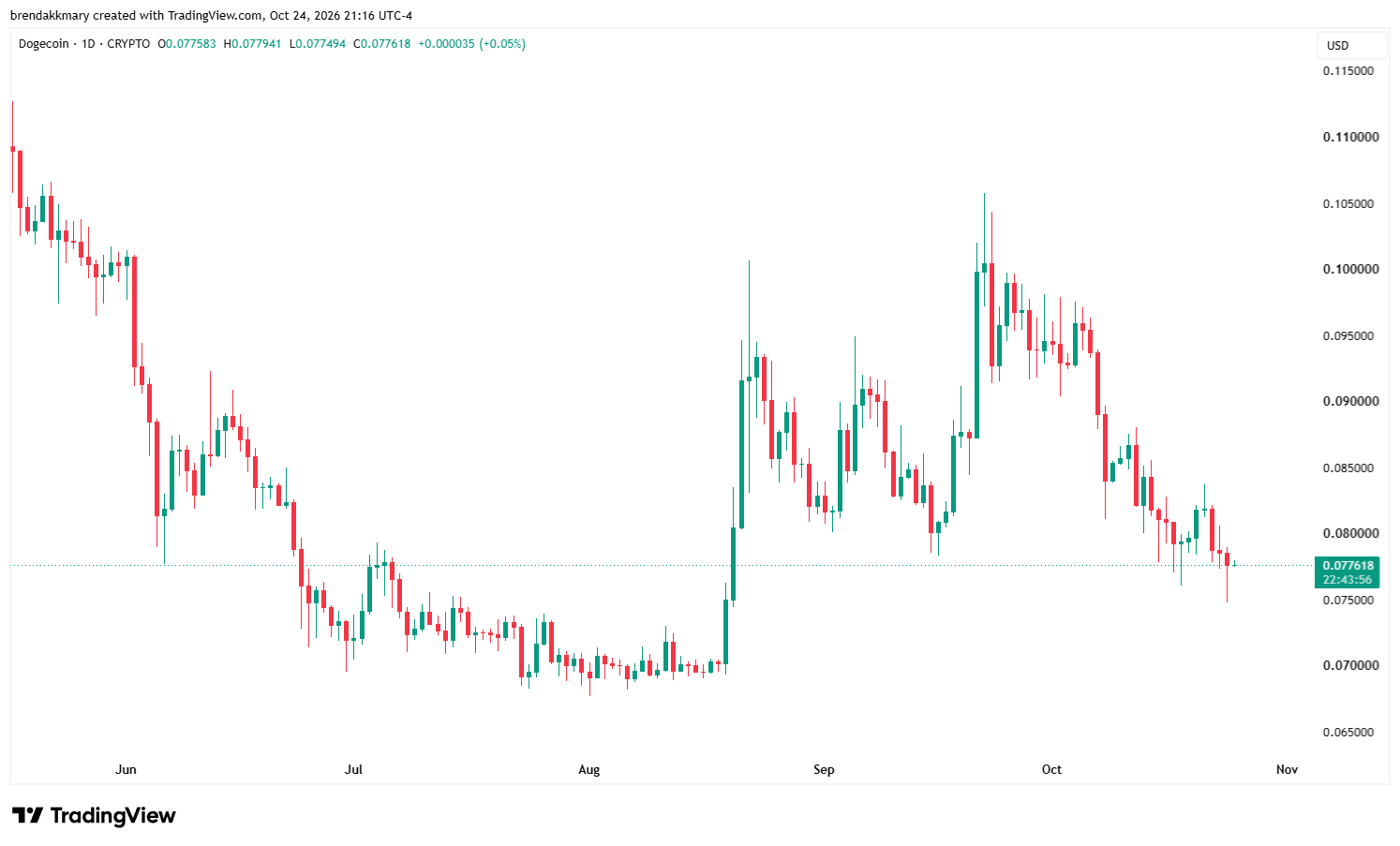
Low funding rates and declining open interest point to muted leveraged demand, while DOGE remains below key moving averages. These signals suggest weakness but do not identify the session’s trigger.
Near-term technical levels put $0.075 in focus. Holding above support could allow consolidation; a break could expose the $0.07498 swing low. The nearby support and swing low leave little room, making a decisive break significant for short-term positioning. Traders are also watching Bitcoin’s ability to stay above $80,000 as a gauge of altcoin appetite.
The post DOGE Contributor Mishaboar Urges Dogecoin Businesses to Back Open-Source Growth appeared first on Blockonomi.
news
SpaceX stock falls below its IPO price despite 92% revenue growth as Thursday’s lock-up expiry threatens to add insider supply.
For over 350 years (roughly since 1661 when the first banknotes appeared in Europe), the relationship between gold and paper money has shaped global finance.


